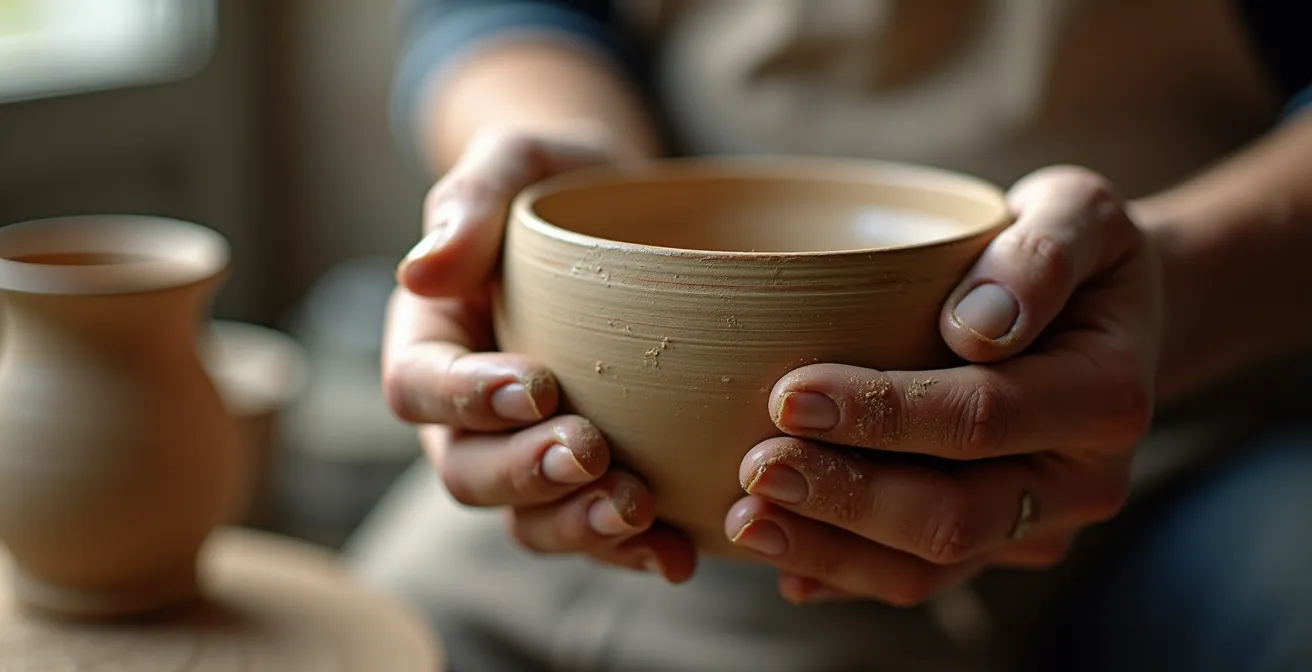
Authentic craftsmanship is verified not by simple imperfections, but by tracing a complete ‘chain of provenance’ from the artist to the finished piece.
- Look for ‘process signatures’—the unique marks left by hand-tooling that machines cannot replicate.
- Verify the artist’s story through work-in-progress photos, studio insights, and even documented failures.
Recommendation: Before buying, investigate the maker’s digital footprint. An authentic artist has a documented creative journey, not just a product catalog.
In the vast digital marketplace, the term “handmade” has become a battleground. You find a rustic leather wallet on Etsy, charmed by its story, only to discover the same item on AliExpress for a fraction of the price. This experience leaves discerning consumers feeling deceived, questioning whether it’s possible to support genuine artisans without being duped by clever marketing. The common advice—to “look for imperfections”—is a romantic but ultimately flawed strategy. Minor flaws are easily replicated by mass-producers to feign authenticity.
The true connoisseur, the careful curator, knows that genuine craft is not defined by its quaint irregularities but by its verifiable history. The key lies in shifting your perspective from that of a mere shopper to that of an investigator. Instead of searching for flaws, you must learn to trace what is known as the chain of provenance—an unbroken line connecting the raw materials, the artist’s unique process, their personal story, and the final object in your hands. This approach moves beyond surface-level aesthetics and into the very soul of the work.
This guide will not give you a simple checklist of “handmade signs.” Instead, it will equip you with a curatorial mindset. We will deconstruct the price of a truly handmade object, decode the language of brand storytelling, examine the physical evidence left by different creation methods, and expose the red flags of deceptive outsourcing. By the end, you will be able to distinguish an object with a soul from a soulless replica and invest your money where it truly matters: in the preservation of skill, culture, and creativity.
Summary: A Curator’s Guide: Distinguishing True Craftsmanship From Mass-Produced “Handmade”
- Why a Handmade Ceramic Mug Costs $45 Instead of $5?
- How to Tell Your Brand Story So Customers Connect With Your Process?
- Wheel-Thrown vs. Slip-Cast: Which Pottery Method Ensures Higher Durability?
- The Outsourcing Mistake That Destroys an Artisan Brand’s Reputation
- How to Calculate Your Hourly Wage to Ensure Your Hobby Is Actually a Business?
- The Provenance Gap That Makes Buying Art on eBay Risky
- The Souvenir Mistake That Disrespects Sacred Traditions in Indigenous Regions
- How to Buy Your First Original Artwork Without Getting Ripped Off?
Why a Handmade Ceramic Mug Costs $45 Instead of $5?
The sticker shock experienced when comparing a $45 artisan mug to a $5 factory-made one is the first entry point into understanding true value. The discrepancy isn’t markup; it’s a reflection of economic transparency and the invisible costs embedded in a genuine creative process. A mass-produced item’s price is based on minimizing material cost and maximizing volume. An artisan’s price is a comprehensive account of time, skill, materials, and the inevitable cost of failure.
Consider the myriad of “unbillable hours” that are essential to the craft. For every hour spent physically shaping clay, an artist might spend two or three on photography, marketing, packaging, and customer correspondence. Furthermore, the nature of ceramics means a significant failure rate is built into the process; it’s not uncommon for 15-30% of pieces to crack or warp during the multiple firings. Each successful piece must therefore absorb the cost of its fallen comrades. Add to this studio rent, the high electricity cost of kiln firings, specialized tools, and the decades of practice required to refine one’s technique, and the $45 price tag begins to look not just reasonable, but necessary for survival.
Case Study: The Economics of Artisan Pricing at Verve Culture
Verve Culture exemplifies pricing transparency by building its brand on three criteria: Artisan, Purposeful, and Authentic. Their offerings, like handmade Mexican tortilla presses and Oaxacan hot chocolate, aren’t just products; they are cultural artifacts. The premium price is justified because each purchase directly supports generational craft traditions and the local artisans who use these items daily. This model transforms a simple transaction into a purposeful investment in cultural preservation, demonstrating how a clear ‘why’ behind the price builds immense brand value and customer loyalty.
This financial honesty is a key part of the chain of provenance. An artisan who can articulate these costs isn’t just justifying a price; they are inviting you into the reality of their profession and proving the authenticity of their commitment. The price tag becomes a story of resilience, dedication, and the true cost of creating something unique by hand.
How to Tell Your Brand Story So Customers Connect With Your Process?
There’s something deeply special about buying handmade. It’s not just about the item, but the energy behind it: the care, the hours, the hands. An authentic handmade piece carries soul. A factory product doesn’t.
– Lucky Seven Leather, Guide to Identifying Real Handmade Products
In the age of automated marketing, an authentic brand story is an artisan’s most powerful tool. It’s the narrative thread in the chain of provenance, and its integrity is a primary indicator of legitimacy. A genuine maker doesn’t just sell a product; they share a journey. This is where you must look for narrative integrity: a consistency between the story told, the process shown, and the materials used. Resellers and dropshippers use generic, romantic language, but true artisans provide specific, often unglamorous, evidence.
Look for process documentation that goes beyond perfectly staged final shots. Real makers share photos of their messy workshops, their tools worn with use, and their work-in-progress experiments. Crucially, they aren’t afraid to show what are often called ‘glorious failures’—the cracked pots, the mis-dyed fabrics, the warped wood. These aren’t defects in their brand; they are proof of a real, human-led process of trial, error, and learning. This vulnerability builds a level of trust that polished corporate storytelling can never achieve.
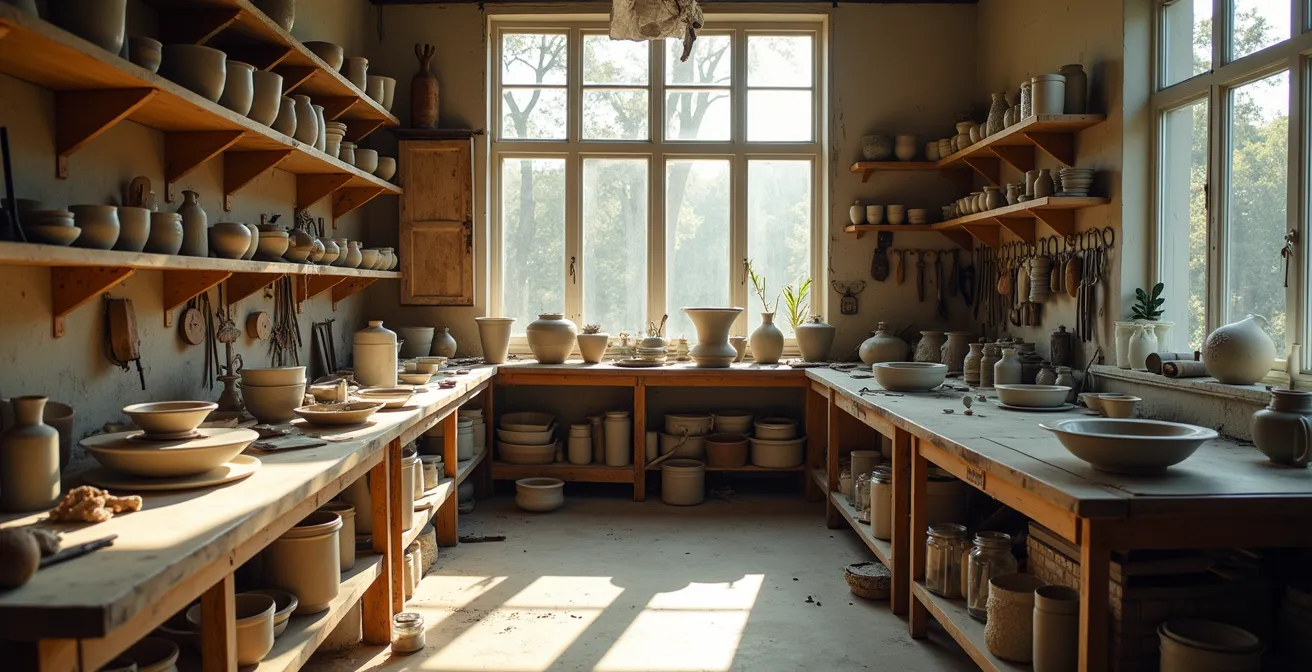
The language used is another critical signal. A real maker’s voice is personal and passionate. They speak about their materials with an intimate knowledge—where the wool was sourced, why they chose a particular wood grain, or how a natural pigment behaves. A reseller, in contrast, will often rely on vague, emotional tropes or corporate filler language. As the checklist below highlights, an authentic story is about sharing, not pitching. It’s an open invitation into a creative world, mess and all.
Authenticity Signals vs. Marketing Tropes
- Story of Origin: Does the brand share a genuine story about materials, the process, or the artisan’s personal journey?
- Process Documentation: Are there photos or videos of the workspace, work-in-progress, and even failed attempts?
- Material Provenance: Can they explain exactly where and why their materials were chosen, as seen in handmade felt purses dyed with natural pigments?
- Personal Voice: Does the communication feel like a person sharing their passion, or a corporation pitching a product?
- Embracing Failure: Do they openly discuss experiments, learning curves, and happy accidents as part of their craft?
Wheel-Thrown vs. Slip-Cast: Which Pottery Method Ensures Higher Durability?
Understanding the production method is like learning to read an object’s DNA. In pottery, the distinction between wheel-thrown and slip-cast pieces reveals different philosophies of creation, each leaving indelible process signatures. While slip-casting can produce items with consistent structural integrity, wheel-throwing imbues each piece with a unique character and evidence of the maker’s hand. Neither is inherently superior in durability—that depends on clay quality and firing—but they tell vastly different stories.
Wheel-throwing is a dialogue between the artist and the clay. The subtle pressure of fingers and tools leaves faint, concentric ‘throwing rings’ on the surface and slight variations in wall thickness. When the piece is cut from the wheel, it often leaves a ‘pontil mark’ on the bottom—a definitive signature of this method. As a result, no two wheel-thrown items are ever identical. These are not flaws; they are the authentic and silent traces of manual creation, a physical record of the artist’s touch.
Slip-casting, by contrast, prioritizes uniformity. Liquid clay (slip) is poured into a plaster mold, which absorbs the water to form a clay shell. The excess is poured out, and the piece is removed. This method allows for rapid, identical production. While it can be an artisanal technique, especially when using handmade molds in small batches, it is also the primary method for mass production. The resulting pieces have perfect symmetry, smooth surfaces, and a lack of the individual markers found in wheel-thrown work.
The following table, based on an analysis of production methods, breaks down the key differences a discerning eye can spot.
| Aspect | Wheel-Thrown | Slip-Cast |
|---|---|---|
| Uniqueness | An artisan will rarely produce two absolutely identical objects. Real artisan products will all be different, even in small details – size, colors, shapes. | Perfect uniformity and consistency |
| Production Time | 30-60 minutes per piece plus drying | 5-10 minutes per piece in molds |
| Durability | Variable based on clay compression | Consistent structural integrity |
| Aesthetic Markers | Throwing rings, pontil marks, slight asymmetry | Smooth surfaces, perfect symmetry |
| Artisanal Value | Each piece unique with maker’s touch | Can be artisanal if using handmade molds in small batches |
The Outsourcing Mistake That Destroys an Artisan Brand’s Reputation
Perhaps the most flagrant violation of the chain of provenance is deceptive outsourcing, where a shop presents itself as a small-scale artisan while actually drop-shipping mass-produced goods. This practice not only defrauds customers but also damages the entire maker economy by eroding trust. Fortunately, these operations often leave behind clear digital and logistical red flags that a savvy buyer can detect. The most obvious is an impossible production volume.
A single artisan, or even a small family team, has a physical limit to their output. When you see an online store with thousands of reviews accumulated over a short period, it’s time to be skeptical. Analysis of online marketplaces reveals that mathematically impossible production volumes often expose dropshipping operations; for example, a shop claiming to be a single artisan with over 35,000 sales in just three years is a massive warning sign. This volume is simply not achievable through genuine hand-crafting. Another red flag is an overly broad and disconnected product catalog. Real artists tend to specialize. If a shop sells handmade leather bags, intricate jewelry, carved wooden sculptures, and custom t-shirts, it’s not a workshop—it’s a catalog.

The ‘Handmade Spectrum’ provides a useful framework for evaluating a brand’s claims. At one end is the 100% hand-crafted item by a single artist. In the middle are transparent collaborations where an artist designs a product and works with a production partner, openly showing their partner’s workshop. At the deceptive end is the drop-shipper who uses stock photos and vague shipping times, often with items arriving from a different country than the artist’s stated location. Learning to spot where a brand sits on this spectrum is key to protecting yourself and supporting true artisans.
How to Calculate Your Hourly Wage to Ensure Your Hobby Is Actually a Business?
For an artisan, transforming a passion into a sustainable business requires a shift from a creative mindset to an entrepreneurial one. This begins with a starkly honest assessment of pricing, anchored in a calculated hourly wage. Many makers, especially early in their careers, underprice their work because they fail to account for all their time and costs, effectively subsidizing their customers’ purchases. A craft remains a hobby until it becomes profitable, and profitability starts with knowing your numbers.
To calculate a true hourly wage, an artisan must first track their time meticulously. This includes not just the ‘making’ time but also the ‘unbillable’ hours for administration, marketing, and shipping. Next, they must tally all material costs and overheads for a given period (e.g., a month). This includes rent, utilities (like kiln firings), tools, software subscriptions, and platform fees. They also need to factor in a realistic failure rate for their specific craft. The total expenses are then added to their desired hourly wage multiplied by total hours worked. This sum, divided by the number of successful items produced, yields the true minimum price per item.
When you purchase authentic crafts, you’re not just paying for the item, you are purchasing the labor, skill, and culture of the artists and their craft. When you purchase handmade crafts, you’re investing in that artist as well as their craft, not just the item.
– Nomad Krafts, Identifying Authentic Crafts Guide
This exercise in economic transparency is not just for the maker; it educates the consumer as well. It demystifies the price tag and reframes the purchase as an investment in a person’s livelihood, skill, and cultural contribution. In a global market where Indian handicrafts exports grew by a remarkable 23% in 2023, the demand for authentic goods is clear. However, this growth is only sustainable if artisans are empowered to price their work fairly, turning their cultural heritage into a viable business, not just a poorly paid hobby.
The Provenance Gap That Makes Buying Art on eBay Risky
Online marketplaces like eBay can be a treasure trove, but they also present a significant “provenance gap”—a lack of verifiable history that separates a genuine artifact from a clever fake. Without a gallery or trusted dealer to vouch for a piece, the burden of verification falls entirely on the buyer. This is where the concept of the chain of provenance becomes an active investigative tool, not just a passive concept. Building this chain requires digital sleuthing to bridge the information gap and establish an item’s authenticity.
Modern tools can help expose deceptive sellers. For instance, browser extensions can perform a reverse image search on product photos, quickly revealing if the same images appear on mass-production sites like AliExpress. While a determined fraudster might steal images from a real maker, this is far less common than resellers using stock photography. Beyond simple image checks, a buyer can investigate the seller’s history on the platform and search for their name or brand on other social media sites. An authentic artist typically has a public-facing creative journey, with a history of posts, work-in-progress shots, and interactions that create a digital footprint over time.
Digital Provenance Verification Methods
The AliSeeks Chrome extension offers a powerful first line of defense, allowing users to right-click an image on a marketplace like Etsy and instantly search for it on AliExpress. This simple action can immediately flag resellers. For deeper verification, buyers can use the Wayback Machine to view older versions of an artist’s website, confirming their creative evolution over time. Searching for the artist’s name in blogs or online publications can also help establish a timeline of their career, solidifying their legitimacy and the authenticity of their work. These digital breadcrumbs are essential for building a modern chain of provenance.
Your Provenance Audit Checklist: 5 Steps to Verify an Artwork
- Points of Contact: List every platform where the artist or item is mentioned (Etsy, Instagram, personal website, eBay, gallery page).
- Collect Evidence: Inventory existing documentation. Gather screenshots of the item listing, product description, and any correspondence with the seller.
- Check for Coherence: Confront the seller’s claims with their digital footprint. Does the story on their website match their Instagram history? Are there inconsistencies?
- Assess Narrative Integrity: Look for personal voice, process documentation (the “messy studio” shots), and a clear specialization versus a generic, sprawling catalog.
- Build a Timeline: Use tools like the Wayback Machine and reverse image searches to confirm the artist’s creative journey and ensure the work isn’t drop-shipped.
The Souvenir Mistake That Disrespects Sacred Traditions in Indigenous Regions
When purchasing crafts from Indigenous communities, the chain of provenance takes on a profound cultural dimension. The common souvenir-hunting mistake is to focus only on the object’s aesthetic appeal while ignoring its story, creator, and cultural significance. This transactional approach risks supporting mass-produced knock-offs that harm the community economically and, more importantly, can lead to the disrespectful use of sacred or restricted designs. An ethical purchase is an act of cultural appreciation, not appropriation.
The first step toward respectful purchasing is to seek out vendors who provide clear and verifiable artisan information. According to experts in the field, virtually 100% of authentic indigenous crafts can be verified with details about the creator and their community. Look for certifications, artist bios, or direct statements of origin. Many Native American artists, for example, sign their work with initials, symbols, or tribal abbreviations. Learning to identify these marks is part of the appreciative process. Moreover, examining the piece for traditional tool marks, like those from hand-saws or files, versus the smooth finish of modern rotary tools, can help authenticate its origin.
Beyond physical inspection, engaging in respectful dialogue is crucial. Asking “Can you tell me the story behind this symbol?” not only enriches your understanding but also helps verify the seller’s knowledge. A legitimate artist or community representative will be able to explain the meaning, whereas a reseller will likely offer a vague or generic response. Similarly, inquiring, “Is this design appropriate for a non-community member to wear?” demonstrates respect for cultural boundaries and helps you avoid purchasing an item that may have restricted ceremonial use. This mindful approach transforms the purchase from a simple acquisition into a meaningful exchange that honors the artist, their heritage, and the living culture behind the craft.
Key Takeaways
- Trace the ‘Chain of Provenance’: Authenticity lies in the verifiable link between materials, process, and the artist’s story.
- Read the ‘Process Signatures’: Look for physical evidence left by hand tools—like throwing rings on pottery or hand-stitching on leather—that machines can’t fake.
- Verify the Narrative: Cross-reference an artist’s story with their digital footprint, including work-in-progress photos and even documented failures.
How to Buy Your First Original Artwork Without Getting Ripped Off?
Acquiring your first piece of original artwork is a deeply personal and rewarding milestone. It marks a transition from consumer to collector. However, navigating the art market requires the same curatorial diligence we’ve discussed. The final step in the chain of provenance is the purchase itself, and understanding the different channels and their pricing dynamics is essential to ensure you are making a sound investment, both financially and emotionally.
Identifying and understanding Native American jewelry is an incredibly rewarding pursuit—one that blends art history, cultural heritage, and personal discovery. Whether uncovering the meaning behind a hallmark or appreciating subtle craftsmanship of an unsigned piece, you participate in a legacy of storytelling through silver, stone, and spirit.
– The Southwestern Style Gallery, How to Authenticate Native American Jewelry
The most common purchasing channels are directly from the artist, through a gallery, or via an artist cooperative. Each has distinct benefits and cost structures. Buying directly from the artist’s studio or website ensures 100% of your money supports them directly and often offers the most personal connection. However, it requires you to do your own research and validation. A gallery purchase provides third-party validation and established provenance, but this curation service comes at a cost—galleries typically add a 40-60% commission to the artist’s price. Artist cooperatives offer a middle ground, with lower markups and a sense of community-vetted quality.
This table breaks down the dynamics of the most common art purchasing channels:
| Purchase Channel | Price Range | Benefits | Considerations |
|---|---|---|---|
| Gallery Purchase | 40-60% markup | Validation, curation, established provenance | Higher cost due to gallery commission |
| Direct from Artist | Base price | Personal connection, studio visit opportunity, full amount to artist | Less market validation, self-research needed |
| Artist Cooperatives | 10-20% markup | Promotes fine craftsmanship as inherently sustainable and human-centered production. | Limited selection, varying quality standards |
| Online Platforms | Variable | Wide selection, convenience | Cannot physically inspect before purchase |
Ultimately, there is no single “best” way to buy. The right choice depends on your confidence, budget, and desire for connection. By applying the investigative principles of tracing provenance, verifying the narrative, and understanding the economics, you are no longer just a buyer. You are a patron, a supporter, and an active participant in an artist’s story. You are investing not just in an object, but in the enduring power of human creativity.
Your first purchase is a statement of your values. By choosing to invest in authentic, verifiable craftsmanship, you are casting a vote for a more transparent, sustainable, and human-centered creative economy. Begin applying this curatorial mindset today to discover and support the true artisans who enrich our world.
Frequently Asked Questions about How to Distinguish True Craftsmanship From Mass-Produced “Handmade” Goods?
Can you tell me the story behind this symbol?
This opens dialogue about cultural significance and helps identify if the seller truly understands the piece’s meaning or is simply reselling.
Is this design appropriate for a non-community member to wear/display?
Shows respect for cultural boundaries and helps avoid purchasing sacred or restricted designs meant only for community members.
Are younger members of the community being taught this craft?
Choosing authentic Indigenous crafts is more than buying a decorative object. It’s an act of respect for living cultures, encouragement of passionate creators, and contribution to transmitting unique heritage.