
Blockchain’s real power isn’t just transparency; it’s creating undeniable proof that makes your sustainability story impossible to dismiss as greenwashing.
- It replaces static, forgeable PDF certificates with a dynamic, unchangeable “provable narrative” for every product.
- Success hinges on securing the “physical-digital bridge”—the point where real-world products are first entered onto the chain.
Recommendation: Start by mapping a single product’s journey to identify critical data points, rather than by choosing a technology. This map is your blueprint for a successful pilot.
As a business owner in the fashion or food industry, you face relentless pressure. Consumers demand sustainability, but they are also increasingly skeptical, armed with the term “greenwashing” and ready to call out any brand whose claims seem hollow. You invest in ethical sourcing, sustainable materials, and responsible partners, but how do you prove it? For years, the answer has been a collection of paper documents: PDF certificates, audit reports, and supplier declarations. But in a digital world, this paper trail feels fragile and insufficient.
This traditional system is built on trusting a document. Anyone can edit a PDF or forge a certificate. This creates a gap between your actions and your customers’ trust. But what if the very foundation of trust could be redesigned? What if, instead of trusting a document, you could trust a process? This is the fundamental shift that blockchain technology offers for supply chain verification. It’s not just another database; it’s a new way to build and share a product’s life story, one that is visible, verifiable, and permanent.
This visionary yet practical approach moves proof from a separate file to an intrinsic part of the product itself. It allows you to build a provable narrative that isn’t just told, but demonstrated with every scan of a QR code. This article will guide you through this new paradigm. We will explore why a shared ledger is inherently more trustworthy, how to create “digital twins” for your products, the critical risks to manage, and the strategic decisions you’ll face when implementing a system that transforms your CSR strategy from a cost center into a powerful driver of profit and brand loyalty.
text
This guide breaks down the core concepts and strategic choices you’ll face when using blockchain to validate your supply chain. The following sections will walk you through the journey from foundational principles to practical implementation.
Summary: Beyond the PDF: How Blockchain Verifies Sustainable Supply Chain Claims
- Why a Shared Ledger Is More Trustworthy Than a PDF Certificate?
- How to Create “Digital Twins” for Luxury Goods to Prevent Counterfeiting?
- Private Blockchain vs. Public Ledger: Which Fits Corporate Privacy Needs?
- The “Garbage In, Garbage Out” Risk at the Physical-Digital Bridge
- When to Join an Industry Consortium vs. Building Your Own Chain?
- Glass vs. Aluminum: Which Beverage Container Is Truly Better for the Planet?
- The Provenance Gap That Makes Buying Art on eBay Risky
- How to Implement a CSR Strategy That Actually Improves Profit Margins?
Why a Shared Ledger Is More Trustworthy Than a PDF Certificate?
A traditional sustainability certificate is a static snapshot in time. It’s a PDF, an email attachment, a piece of paper in a filing cabinet. Its trustworthiness relies entirely on the authority of the single entity that issued it. Once created, it can be easily copied, altered, or presented out of context. A blockchain ledger fundamentally changes this dynamic by creating a living, shared, and immutable record of truth. It’s not a document; it’s a continuously updated story to which all permitted participants bear witness.
Instead of a single point of failure, a blockchain distributes and decentralizes verification. Every transaction—from a batch of organic cotton leaving the farm to a garment being shipped from the factory—is a block of data cryptographically linked to the one before it. This chain cannot be altered without invalidating all subsequent blocks, an act that would be immediately visible to all parties on the network. This systemic integrity is why Walmart’s blockchain implementation reduced food source tracing time from 7 days to a mere 2.2 seconds. The data wasn’t buried in one department’s inbox; it was an accessible, real-time feature of the network itself.
This shift from a static certificate to a dynamic audit trail offers several key advantages:
- Real-time Tracking: Every transaction is recorded and visible to all network participants instantly, not just at the end of a reporting period.
- Immutable Audit Trail: Records cannot be deleted or altered once entered into the blockchain, creating a permanent history.
- Distributed Verification: Multiple parties validate data instead of relying on a single, fallible certifier.
- Smart Contract Automation: Business rules, like “release payment only when goods arrive at port,” are encoded and executed automatically, reducing the need for intermediaries.
In essence, a PDF proves that someone *claimed* something was true on a specific date. A blockchain ledger proves that a series of events actually happened, in order, and were verified by the entire network along the way. For a business owner fighting greenwashing claims, this is the difference between showing a diploma and showing the entire transcript.
How to Create “Digital Twins” for Luxury Goods to Prevent Counterfeiting?
For high-value goods, from haute couture to fine watches, provenance is not just a matter of sustainability—it’s the foundation of value itself. The fear of counterfeits erodes consumer trust and devalues a brand. A “digital twin” is the solution to this problem: a unique, unforgeable digital identity on the blockchain that is permanently tethered to a physical item. It acts as a digital birth certificate and a lifelong passport for the product.
Creating a digital twin starts at the moment of creation or sourcing. A unique identifier—a secure QR code, an NFC chip embedded in the product, or a serialized number—is assigned to the physical item. This identifier is then used to create the first block in the chain for that specific product. Every subsequent event in its lifecycle—shipping, quality control, sale, and even resale—is added as a new block to its unique chain. A consumer can then scan the physical item to access this entire, unalterable history.

This technique provides an unprecedented level of assurance. De Beers Group, for example, successfully used its blockchain platform to track high-value diamonds from the mine all the way to the retail counter. This initiative, as detailed in their case study, solved two of the industry’s biggest challenges at once: it helped prevent the trade of conflict diamonds and provided absolute, verifiable proof of provenance for polished gems. The digital twin transformed the diamond from a simple commodity into a fully documented asset with a provable narrative.
Private Blockchain vs. Public Ledger: Which Fits Corporate Privacy Needs?
When business owners first hear “blockchain,” they often think of public ledgers like Bitcoin or Ethereum, where every transaction is visible to everyone. This level of radical transparency is unworkable for a competitive enterprise. You don’t want your competitors seeing your pricing, supplier lists, or shipping volumes. This is where permissioned blockchains—private or consortium—become essential for supply chain applications. They are designed to provide cryptographic certainty without sacrificing corporate privacy.
A private blockchain is operated by a single organization. It offers maximum control and speed, as you set all the rules. It’s ideal for internal processes where you want to create an immutable audit trail for different departments. A consortium blockchain, by contrast, is governed by a pre-selected group of members, such as a brand, its key suppliers, and a logistics partner. It’s the most common model for supply chains, as it allows for trusted data sharing between independent companies. As the IBM Food Trust documentation highlights, this model operates on a “need-to-know” basis. The platform’s lead architect, quoting from the official documentation, explains the core principle:
Participants determine what data is seen by whom, thereby providing information on a need-to-know basis.
– IBM Food Trust, IBM Blockchain Solutions Documentation
This selective disclosure is the key. You can prove to a customer that a handbag was made with Italian leather without revealing which tannery you used or the price you paid. The choice between public, private, and consortium models depends entirely on your business goals, as this comparative analysis from IBM shows.
| Feature | Public Blockchain | Private/Permissioned Blockchain | Consortium Blockchain |
|---|---|---|---|
| Access Control | Open to all | Restricted to organization | Limited to member organizations |
| Data Visibility | Fully transparent | Internal only | Selective sharing via channels |
| Consensus Speed | Slow (minutes) | Fast (seconds) | Fast (seconds) |
| Scalability | Limited | High | High |
| Best For | Cryptocurrencies | Internal processes | Supply chain partnerships |
For most brands in fashion and food, a consortium blockchain offers the best balance of security, efficiency, and collaborative trust.
The “Garbage In, Garbage Out” Risk at the Physical-Digital Bridge
A blockchain is immutable. It perfectly preserves whatever data is put into it. But it cannot magically verify that the data was accurate at the moment of entry. This is the single greatest risk in any supply chain project: the physical-digital bridge. If a supplier claims a batch of cotton is organic and enters it as such onto the blockchain, the ledger will faithfully record it as “organic” forever—even if it isn’t. This is the “garbage in, garbage out” (GIGO) problem, and securing this initial entry point is the most critical task in building a trustworthy system.
The integrity of your entire provable narrative depends on the quality of the data at its source. Trust is not created by the blockchain alone, but by the robust processes you build around it. The goal is to make it easier to be honest than to be dishonest and to create automated checks that don’t rely solely on human input. This involves a combination of technology, process design, and incentives.
To mitigate the GIGO risk, you must fortify the physical-digital bridge with multiple layers of verification. Effective strategies include:
- Deploying IoT (Internet of Things) sensors for automated data capture of temperature, humidity, and location, removing the chance of human error.
- Implementing tamper-proof NFC seals on containers, which can digitally confirm if a shipment has been opened.
- Requiring geo-tagged, time-stamped photo or video evidence from certified third-party auditors at critical handoffs.
- Designing smart contracts that financially reward or penalize suppliers based on the accuracy of their data entry.
- Establishing multi-party verification protocols, where, for instance, both the farmer and the shipping agent must digitally sign off on a shipment’s contents before it can proceed.
By focusing your efforts here, you ensure that the information entering your immutable ledger is as close to the ground truth as possible, making the entire system worthy of your customers’ trust.
When to Join an Industry Consortium vs. Building Your Own Chain?
Once you’ve decided to explore blockchain, you face a major strategic fork in the road: do you build a proprietary system from scratch, or do you join an existing industry consortium? Building your own private chain gives you total control over governance, features, and data. However, it’s also incredibly expensive, requires deep technical expertise, and can create a “walled garden” that’s difficult to connect with partners who aren’t on your specific system.
Joining an industry consortium, on the other hand, offers shared costs, established standards, and immediate network effects. When competitors collaborate on the underlying “rails” of trust, everyone can build value on top more quickly. A prime example of this is the Mobility Open Blockchain Initiative (MOBI). In 2018, car manufacturers representing over 70% of global vehicle production, including giants like BMW, Ford, and Renault, formed this consortium. By pooling resources, they could tackle industry-wide problems like vehicle identity, usage history, and autonomous data exchange in a way that would be impossible for any single company to achieve alone.
For most fashion and food businesses, the consortium approach is far more practical. It allows you to leverage a proven platform and connect with a pre-existing network of suppliers and partners. However, before joining any group, a thorough due diligence process is essential. You must ensure the consortium’s goals, governance, and data policies align with your own strategic interests.
Action Plan: Your Decision Framework for a Blockchain Strategy
- Evaluate Governance: Who makes the rules for the network? How are disputes resolved? Ensure the model is fair and protects your interests.
- Assess Data Ownership: What control do you retain over your data? Clarify who can see what information and under what conditions.
- Analyze Cost Structure: Compare the long-term costs of a pay-per-transaction model versus flat membership fees. Model your expected usage to project expenses.
- Check Interoperability: Can the consortium’s system connect with other blockchains or your existing ERP systems? Avoid getting locked into a proprietary dead-end.
- Review Competitive Positioning: Consider the trade-offs between being a first-mover with influence versus a fast-follower with more efficiency and less risk.
Choosing to build versus join is a decision that will shape your company’s digital strategy for years to come. It requires a careful balance of control, cost, and collaboration.
Glass vs. Aluminum: Which Beverage Container Is Truly Better for the Planet?
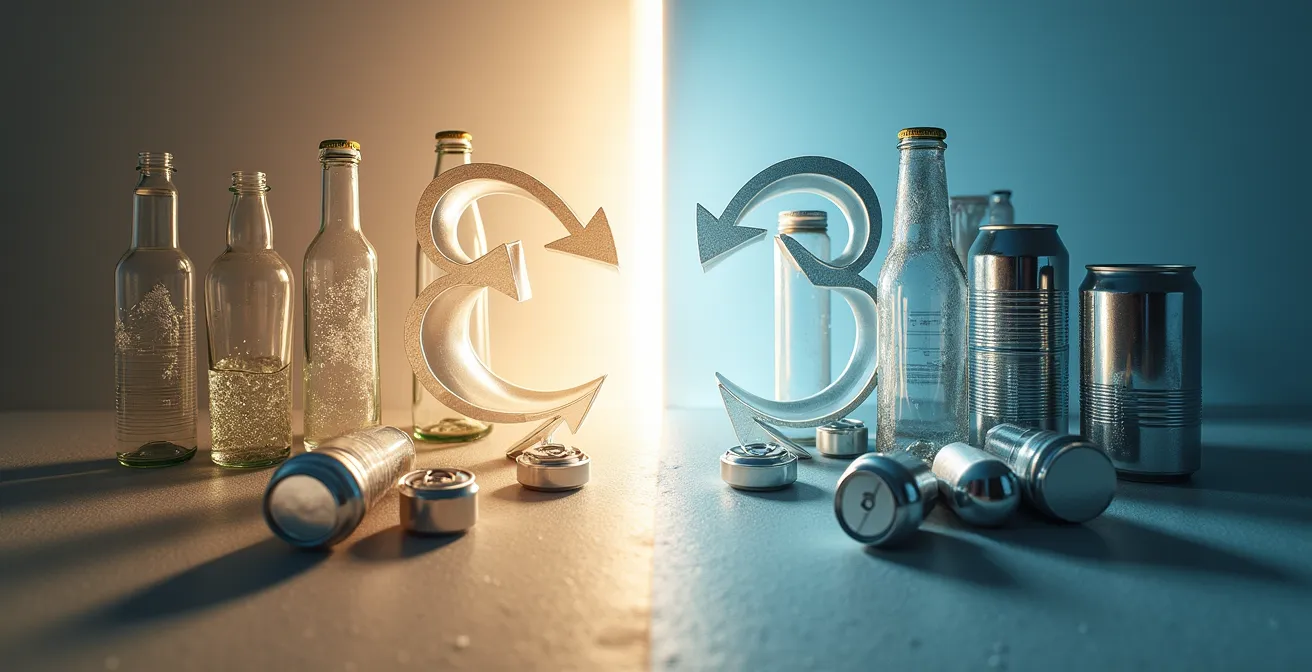
Consider a seemingly simple sustainability question: is a glass bottle or an aluminum can better for the environment? The answer is incredibly complex. Aluminum is lighter to transport, reducing fuel emissions, but its primary production is energy-intensive. Glass is heavier, but it’s made from abundant materials and can be reused more times before recycling. A simple “100% Recyclable” label on either is a form of greenwashing because it tells a fraction of the story. It ignores transportation impact, water usage, and the actual rate of recycling in the consumer’s region.
This dilemma perfectly illustrates the limits of static claims and the need for a dynamic, provable narrative. A brand committed to true sustainability could use blockchain to trace the entire lifecycle. A digital twin for a batch of bottles could record the percentage of recycled material used, the energy source of the manufacturing plant, the transport distance, and even confirm its return to a recycling facility. This transforms a vague claim into a rich, data-backed story.
Without such a system, supply chains are notoriously opaque and rife with misinformation. The food industry provides a stark warning. An Oceana study revealed that seafood is frequently mislabeled, with some species having an astonishing mislabeling rate of up to 87%. This happens because the “provenance” is just a piece of paper that changes hands multiple times, with each step offering an opportunity for fraud. Whether it’s fish, aluminum, or cotton, the principle is the same: if the proof isn’t bound to the product, it can’t be fully trusted.
The Provenance Gap That Makes Buying Art on eBay Risky
The art market is an entire industry built on a single concept: provenance. The history of ownership of a piece of art is what guarantees its authenticity and, therefore, its value. A painting attributed to a master is priceless; the same painting, revealed as a clever fake, is worthless. This “provenance gap” is most acute in secondary markets like eBay, where buyers have little more than a seller’s description and a few JPEGs to go on. There is no independent, verifiable chain of custody, creating a haven for forgeries and misattributed works.
This high-stakes environment is a perfect microcosm of the problem that blockchain solves for all unique or high-value goods. The technology can create a permanent, unforgeable digital provenance record—a “digital passport” for an asset that travels with it from creator to every subsequent owner. Each sale, exhibition, or appraisal is recorded as a time-stamped, cryptographically-secured entry on the ledger. This digital history cannot be faked or retroactively changed, effectively eliminating the risk of fraud.
The company Everledger pioneered this model for the diamond industry, another field where value is tied to authenticity and ethical sourcing. As described in a recent analysis, their platform creates an immutable digital record for each stone, tracking its journey from mine to retail. This system has become a new industry standard for preventing fraud in high-value gemstone trading. It demonstrates how digital twins and verifiable histories can completely transform trust in markets traditionally plagued by a lack of transparency. The same logic applies to a limited-edition sneaker, a vintage handbag, or a piece of fine art.
By closing the provenance gap, blockchain doesn’t just protect buyers; it protects the brand’s value by ensuring that only authentic goods can carry the brand’s verifiable story.
Key takeaways
- Blockchain builds trust in a process, not a document, making sustainability claims verifiable and resilient against greenwashing accusations.
- The biggest risk is the “physical-digital bridge”; securing the initial data entry with technology like IoT and NFC seals is non-negotiable.
- The right strategy—joining a consortium versus building a private chain—is a critical business decision that depends on your industry, resources, and long-term goals.
How to Implement a CSR Strategy That Actually Improves Profit Margins?
For too long, many businesses have viewed Corporate Social Responsibility (CSR) as a cost center—a tax on profits paid in the form of sustainability reports and ethical sourcing premiums. But this is an outdated perspective. In today’s market, a provable CSR strategy is a powerful driver of revenue and brand equity. The visionary leader understands that transparency is not an expense; it’s an investment in the most valuable asset of all: customer trust. When that trust is earned through undeniable proof, it translates directly to the bottom line.
The key is “provable.” Any brand can claim to be sustainable, but customers are willing to pay more for brands that can prove it. Research shows that over eight in 10 consumers will pay a premium for products with transparent, ethically sourced origins. Blockchain is the tool that unlocks this premium by connecting your CSR actions directly to the product the customer holds in their hand. It allows you to charge more not just because you say you’re better, but because you can show them the evidence.
Consider Nestlé’s implementation of the IBM Food Trust blockchain for its premium coffee brand, Zoégas. In 2020, they partnered with the Rainforest Alliance to trace coffee from specific farmer co-ops in Brazil and Colombia. Customers can now scan a QR code on the package to see the coffee’s journey, including when it was harvested, the roasting period, and verification of its sustainability certifications. This initiative did more than just improve brand trust; it allowed Nestlé to justify a premium price point while simultaneously demonstrating its commitment to supporting farmers who follow environmentally sound practices. It turned their CSR strategy into a market differentiator and a tangible product feature.
By using blockchain to make your supply chain transparent, you are not just ticking a CSR box. You are building a powerful marketing story, creating a price-premium justification, and forging a deeper, more resilient connection with your customers.
The journey towards a provably sustainable supply chain begins not with technology, but with a strategic decision. Start by mapping a single product’s journey in detail. Identify every handoff, every data point, and every moment where trust is currently assumed rather than proven. This map will become the blueprint for your first pilot project, turning a visionary concept into a practical and profitable reality.