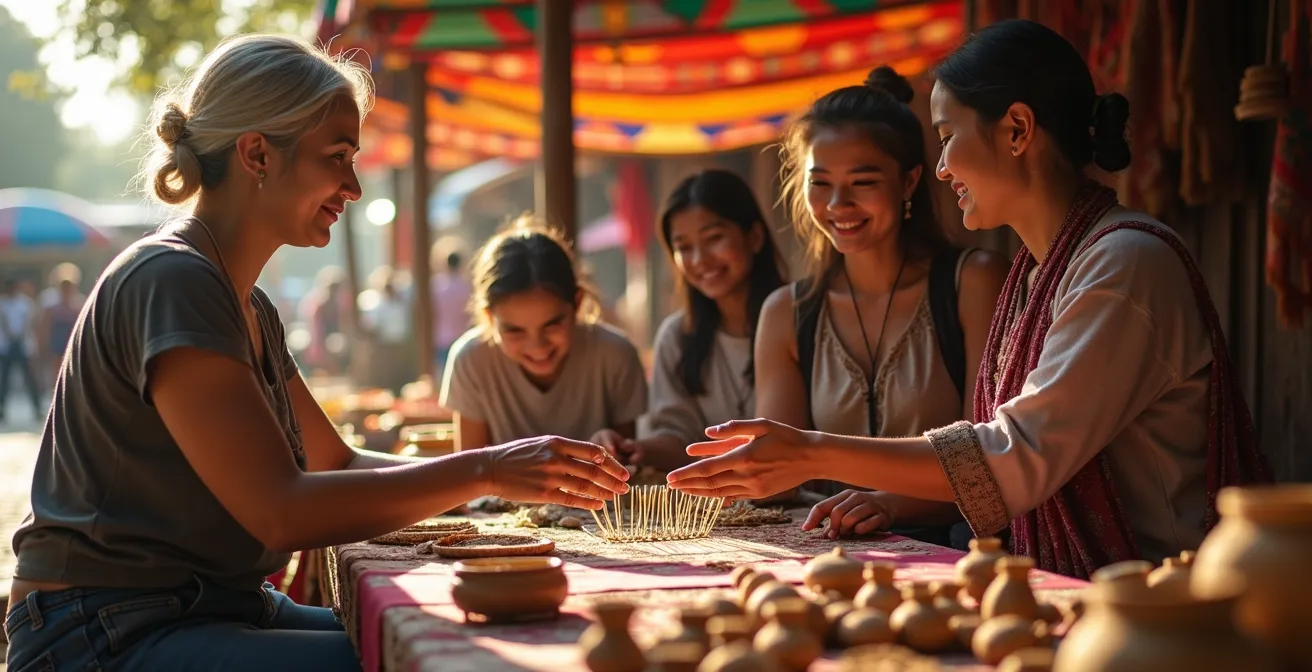
Your travel spending often fails to reach local families due to a hidden system called “economic leakage,” but you have the power to change that.
- Large-scale tourism, like all-inclusive resorts, can divert up to 80% of revenue away from the local community.
- Conscious choices in accommodation, souvenirs, and even daily interactions can redirect funds to the people who need them most.
Recommendation: Actively investigate supply chains, choose community-based lodging, and buy directly from artisans to ensure your money fosters local prosperity, not corporate profits.
As a traveler, your intention is often to connect with a new place and, ideally, contribute positively to the lives of the people who call it home. You carefully choose local restaurants and buy handcrafted souvenirs, believing your money is making a difference. Yet, the frustrating reality is that a significant portion of tourist spending never reaches the local community. This phenomenon, known as economic leakage, funnels revenue back to international corporations through a complex web of foreign-owned hotels, imported goods, and non-local tour operators.
Many guides will offer surface-level advice: “eat local” or “shop local.” While well-intentioned, this advice often fails to address the underlying systemic issues. The real problem isn’t just about what you buy, but understanding the entire economic chain your purchase supports. But what if the key wasn’t simply choosing a local-looking storefront, but learning to identify and support businesses with truly transparent and community-integrated supply chains? What if you could become an active economic agent, capable of dismantling leakage one intentional purchase at a time?
This guide is designed to move you beyond generic tips. It provides a framework for understanding the mechanisms that divert your money and offers concrete strategies to ensure your spending becomes a powerful tool for direct community support. We will explore how to assess accommodation, engage respectfully with local people, and make purchases that honor culture and empower families.
Summary: A Conscious Traveler’s Guide to Supporting Local Economies
- Why All-Inclusive Resorts Often Contribute Less Than 10% to the Local Economy?
- How to Ask for Photos of People Without Being Intrusive or Rude?
- Homestays vs. Chain Hotels: Which Provides a Truer Cultural Exchange?
- The Airbnb Effect: When Your Rental Prices Locals Out of Their Neighborhood
- When and How Much to Tip in Cultures That Don’t Usually Tip?
- The Souvenir Mistake That Disrespects Sacred Traditions in Indigenous Regions
- How to Audit Tier 2 Suppliers to Ensure No Forced Labor Is Involved?
- How to Distinguish True Craftsmanship From Mass-Produced “Handmade” Goods?
Why All-Inclusive Resorts Often Contribute Less Than 10% to the Local Economy?
The allure of an all-inclusive resort is its simplicity: one price for everything. However, this convenience often comes at a steep cost to the local economy. The core issue is “economic leakage,” a term for when revenue generated by tourism “leaks” out of the host country instead of circulating locally. These resorts are frequently foreign-owned, meaning profits are repatriated. They also tend to import food, beverages, and supplies from international distributors to maintain brand consistency, bypassing local farmers and producers.
The result is a closed economic loop where tourist dollars primarily enrich overseas corporations. In fact, the problem is so pronounced that studies have shown an 80% leakage rate in some Caribbean countries. While resorts do create jobs, they are often low-wage positions with limited opportunities for advancement. This creates a facade of economic benefit while the vast majority of the wealth generated on local land is extracted.
To counter this, a traveler, even one staying at such a resort, must become an agent of intentional spending. This means actively seeking opportunities to spend money outside the resort’s closed system. It requires a conscious effort to break free from the “captive” environment and engage directly with the local economy. Simple actions like hiring a local taxi driver for a day trip or eating at a family-owned restaurant in a nearby town can inject capital where it’s most needed. The goal is to consciously divert a portion of your travel budget to businesses that are verifiably local.
Ultimately, choosing to spend even one day’s budget outside the resort walls can have a more significant positive impact than a week’s worth of spending within them.
How to Ask for Photos of People Without Being Intrusive or Rude?
A vibrant market, a traditional ceremony, an artisan at work—these are compelling scenes you may want to capture. However, the act of taking a person’s photograph without their consent can feel extractive, turning a human being into a part of the scenery. The foundation of responsible travel photography is not technical skill, but respect and human connection. It’s about shifting from a mindset of “taking” a picture to one of “creating” a portrait collaboratively.
The first step is to engage before you even think of raising your camera. A smile, a greeting in the local language, or showing interest in what the person is doing builds a bridge of communication. This simple act acknowledges their humanity beyond their role as a photographic subject. When you do decide to ask, non-verbal cues are powerful. Show your camera and use a questioning gesture. If you’ve learned the local phrase for “May I take your photo?”, now is the time to use it.
This approach transforms the interaction from a transaction into an exchange. By showing them the photo on your screen afterward, you share the result and complete the collaborative circle. If they decline, that decision must be met with a smile and a “thank you” without any sign of disappointment. Their right to privacy and to control their own image is absolute. This respect is far more valuable than any photograph. This human-centered approach ensures your memories are built on positive interactions, not silent intrusions.

As this image of an artisan’s hands at work shows, focusing on the craft and the process can often tell a more powerful story while respecting personal boundaries. It captures the essence of the person’s skill and dedication without being intrusive.
In the end, the best travel photos are often those that carry a story of a friendly encounter, regardless of whether a face is visible.
Homestays vs. Chain Hotels: Which Provides a Truer Cultural Exchange?
Your choice of accommodation is one of the most impactful economic decisions you’ll make on a trip. On the surface, both a large chain hotel and a local homestay provide a bed for the night, but their effects on the local community and the quality of your cultural exchange are worlds apart. A chain hotel operates within a corporate structure, where a small fraction of your payment trickles down into the local economy through low-wage jobs. A homestay, by contrast, directs your money straight into the hands of a local family.
But the difference goes far beyond just economics. Chain hotels are designed for uniformity and isolation, providing a standardized, placeless experience. A homestay, on the other hand, is an invitation into a real home. It offers an unscripted, genuine window into the daily rhythms of life in another culture. You share meals, learn about family traditions, and exchange stories in a way that is simply impossible in the sterile environment of a hotel lobby. This is the difference between observing a culture from a distance and participating in it, however briefly.
The success of community-based tourism models proves this point. A powerful example is found in the homestay programs of Northern Thailand’s hill tribes. As a successful case study in ethical tourism, this model shows how visitors staying with local families directly contribute to household income while engaging in daily activities like farming and craft-making. This creates a virtuous cycle: tourists gain a deep, authentic understanding of the culture, and the community receives direct economic benefits that help preserve its traditions for future generations.
The following table breaks down the impact, illustrating why your choice of lodging is a critical lever for positive change.
| Accommodation Type | Local Economic Retention | Cultural Exchange Quality | Community Benefits |
|---|---|---|---|
| Authentic Homestay | 90-95% stays local | Deep, genuine interactions | Direct family income, cultural preservation |
| Community-Based Tourism Lodge | 80-85% community-managed | Structured cultural activities | Funds community projects, schools, clinics |
| Ethical Chain Hotel | 40-60% through local employment | Limited but respectful | Stable jobs, skills training, local sourcing |
| Traditional Chain Hotel | 10-25% stays local | Minimal interaction | Entry-level jobs only |
By choosing a homestay or a community-run lodge, you are not just booking a room; you are investing in a family, preserving a culture, and enriching your own travel experience immeasurably.
The Airbnb Effect: When Your Rental Prices Locals Out of Their Neighborhood
The rise of short-term rental platforms was initially hailed as a way for travelers to “live like a local” and for residents to earn extra income. While this can be true for owner-occupied rentals, the proliferation of commercially-operated, full-time rental properties has had a damaging side effect in many popular destinations: it has priced actual locals out of their own neighborhoods. This phenomenon, often called the “Airbnb Effect,” occurs when landlords find it more profitable to rent to a constant stream of high-paying tourists than to long-term residents.
This conversion of residential housing into “ghost hotels” shrinks the available housing supply, driving up rental prices and property values for everyone. The result is that the very people who create the vibrant, authentic culture that attracts tourists—artists, service workers, young families—are forced to move away. The neighborhood loses its soul, becoming a transient zone of tourists and lockboxes. Your desire to “live like a local” can, paradoxically, contribute to a reality where no locals can afford to live there anymore.
However, conscientious travelers can push back against this trend by supporting alternative models designed for community benefit. These platforms and initiatives are part of a growing movement toward regenerative tourism, which aims not just to sustain, but to actively improve the host community. A leading example is Fairbnb.coop, a cooperative platform that rethinks the entire model. As their mission states, they are built on a different set of values:
Fairbnb.coop directs 50% of its commission to community projects chosen by local nodes, creating a regenerative tourism model where each booking directly funds local social initiatives.
– Fairbnb.coop Platform, Fairbnb Official Platform Description
By choosing platforms that are legally compliant, promote owner-occupied rentals, and invest a portion of their revenue back into the community, you can ensure your stay supports neighborhood stability rather than contributing to displacement.
True local living means being a good neighbor, and that starts with ensuring your presence doesn’t push the actual neighbors out.
When and How Much to Tip in Cultures That Don’t Usually Tip?
Navigating tipping customs can be one of the most awkward aspects of international travel. In many cultures, particularly in parts of Asia and Europe, tipping is not a standard practice and can sometimes be seen as confusing or even offensive. Service staff are paid a full living wage, and excellent service is considered part of the job, not something that requires an extra reward. Forcing a tip in these contexts can create an uncomfortable power dynamic and may be perceived as showing off wealth or implying their salary is insufficient.
However, as a traveler who has received exceptional, above-and-beyond service from a guide, a guesthouse owner, or a driver, you may still feel a strong desire to express your gratitude. The key is to reframe the gesture from a “tip” to a “gift.” This subtle shift in mindset and presentation can make all the difference. A tip is an impersonal transaction; a gift is a personal expression of appreciation. This approach respects local customs while still allowing you to show your heartfelt thanks.
There are many culturally sensitive ways to do this. Instead of leaving cash on a table, you might enclose it in an envelope with a handwritten thank-you note. You could present it as “a small gift for your children” or discreetly pass it during a farewell handshake. The goal is to avoid the public spectacle of a service payment and instead create a moment of genuine, personal connection. Sometimes, non-monetary expressions of gratitude are even more valued, such as writing a glowing online review that mentions the staff member by name or sending a formal letter of commendation to their manager.

As this image suggests, the act of giving can be a quiet, respectful exchange. A small, thoughtful gift from your home country, presented with sincerity, can often be more meaningful than cash.
Ultimately, the most important thing is that your gesture comes from a place of genuine appreciation and is delivered with cultural sensitivity and respect.
The Souvenir Mistake That Disrespects Sacred Traditions in Indigenous Regions
Buying a souvenir should be a happy memory, a tangible piece of your journey that supports a local artisan. However, this simple act can become deeply problematic in regions with rich Indigenous traditions. The line between a commercial craft and a sacred object is often invisible to an outsider, and tourist demand can inadvertently fuel the commodification of culture. This happens when items with deep spiritual or ceremonial significance are mass-produced and stripped of their meaning to be sold as trinkets.
Purchasing what appears to be an innocent mask, textile, or carving could mean you are participating in a cycle that devalues sacred traditions. In the worst-case scenario, it can even encourage the looting of ancient sites and the illegal trafficking of cultural heritage. The International Council of Museums (ICOM) highlights the severity of this issue, which is driven by an often-unwitting market.
Tourist demand for artifacts, however innocent, fuels a chain of looting and illegal trafficking that destroys archaeological sites and erases cultural heritage.
– ICOM (International Council of Museums), Red Lists of Cultural Objects at Risk
So, how can you be a responsible buyer? The key is to become an informed consumer. This requires moving beyond the tourist markets and seeking out artisans in their own workshops. It means asking questions and listening to the stories behind the objects. A true artisan can explain the process, the materials, and the meaning of the patterns. A seller of mass-produced goods cannot. Your curiosity is your best tool for distinguishing between authentic craft and disrespectful replicas.
Action Plan: Assessing Sacred vs. Commercial Artifacts
- Location Test: Is the item being sold in the artisan’s own workshop or at a generic tourist market stall filled with identical items? True artisans are often found where they work.
- Function Test: Ask if locals use this item in their daily lives or for specific ceremonies. If it’s purely for tourists, its cultural connection may be weak.
- Story Test: Can the seller explain the item’s creation process and the cultural meaning behind its design? A lack of story is a major red flag.
- Pattern Analysis: Before you buy, do a quick online search for the meaning of local patterns. Some designs are reserved for spiritual leaders or specific clans and should not be worn by outsiders.
- Age Verification: Be extremely wary of any item claimed to be an “antique.” Ask for official documentation and check the ICOM Red Lists, which catalogue types of cultural objects at risk of being trafficked.
By investing in authentic craftsmanship, you not only get a more meaningful memento but also help preserve the cultural heritage you came to admire.
Key Takeaways
- Economic leakage is the primary obstacle; your goal is to intentionally bypass systems that extract wealth from local communities.
- Your greatest power lies in curiosity: asking questions about where products come from and who benefits from your purchase is the first step toward supply chain transparency.
- True support is founded on respect for people and culture, whether through collaborative photography, honoring traditions, or choosing accommodation that fosters genuine connection.
How to Audit Tier 2 Suppliers to Ensure No Forced Labor Is Involved?
For a truly conscious traveler, ethical spending goes beyond the front line. You might choose a locally-owned hotel, but what about the farm that supplies its vegetables or the factory that produces its linens? These are “Tier 2” suppliers, and their practices are often hidden from view. Ensuring your money doesn’t inadvertently support unethical practices like forced labor deep within the supply chain requires a new level of traveler engagement. While you can’t conduct a formal audit, you can use your voice and your choices to promote transparency.
Your power as a consumer lies in your curiosity. By simply asking questions, you signal to businesses that supply chain transparency matters to their customers. Inquire about where your food comes from. Ask the hotel manager about their sourcing policies for linens and amenities. Choose restaurants that proudly advertise their farm-to-table connections. Businesses that are proud of their ethical and local sourcing will be delighted to share their stories. Those with something to hide will be evasive. Your questions become an informal audit, creating demand for transparency.
Look for businesses that have already done the work for you. Certifications like B Corp, Fair Trade, and Travelife indicate that a business has undergone a rigorous third-party audit of its social and environmental practices, including its supply chain. The most direct way to ensure an ethical supply chain is to patronize businesses where it is completely visible. A prime example is the agritourism model, where visitors stay on a working farm. In this farm-to-table tourism success story, guests can see the entire process from seed to plate, meet the farmers, and know with certainty that their money is supporting that family directly, eliminating all concerns about hidden labor practices.
The “Traveler’s Curiosity Framework” is not about being an investigator; it’s about being an engaged and conscious consumer who champions businesses that are open about their operations. Your inquiries can encourage more businesses to adopt transparent and ethical sourcing.
Start applying these principles on your next trip by asking one simple question: “Can you tell me where this comes from?” Your journey to becoming a truly supportive traveler begins with curiosity.
How to Distinguish True Craftsmanship From Mass-Produced “Handmade” Goods?
In a bustling market, the word “handmade” is everywhere. Yet, many of these items are mass-produced in factories and are “handmade” only in the final, minimal assembly. Distinguishing authentic, artisan-made goods from these impostors is crucial for ensuring your money supports a real local craftsperson, not a distant factory. The good news is that you don’t need to be an expert; you just need to engage your senses and look for the beautiful imperfections that signal a human touch.
True craftsmanship is rarely perfect. A machine can produce a thousand identical items, but an artisan’s hands will leave subtle, unique marks on each creation. Look for slight irregularities: a textile where the stitching isn’t perfectly uniform, a ceramic piece that isn’t perfectly symmetrical, or a wooden carving with visible tool marks. These are not flaws; they are the signature of the creator. Engage your other senses as well. Real leather, wood, and wool have distinct, natural smells, unlike the chemical scent of industrial glues or plastics. A hand-carved wooden bowl will often feel heavier and more solid than a hollow, mass-produced equivalent.
The ultimate test is context. Where is the item being sold? An artisan’s workshop, filled with tools, raw materials, and half-finished projects, is the best place to buy. Here, you can often meet the creator and see the process firsthand. This direct connection guarantees authenticity and allows you to learn the story behind your purchase, making it infinitely more valuable. By training yourself to look, feel, and even smell the difference, you can confidently identify and invest in genuine local art.
This choice has a profound economic impact. According to the World Travel & Tourism Council, a significant portion of the tourism sector is composed of small enterprises. Research shows that as much as 80% of tourism businesses are SMEs, meaning your purchase from a local artisan is a direct investment in a small family enterprise and the preservation of their cultural skills.
Now that you are equipped with these strategies, it’s time to put them into practice. To truly transform the tourism landscape, we must never forget the foundational problem we are trying to solve. Revisit the core issue of economic leakage and solidify your commitment to being part of the solution.