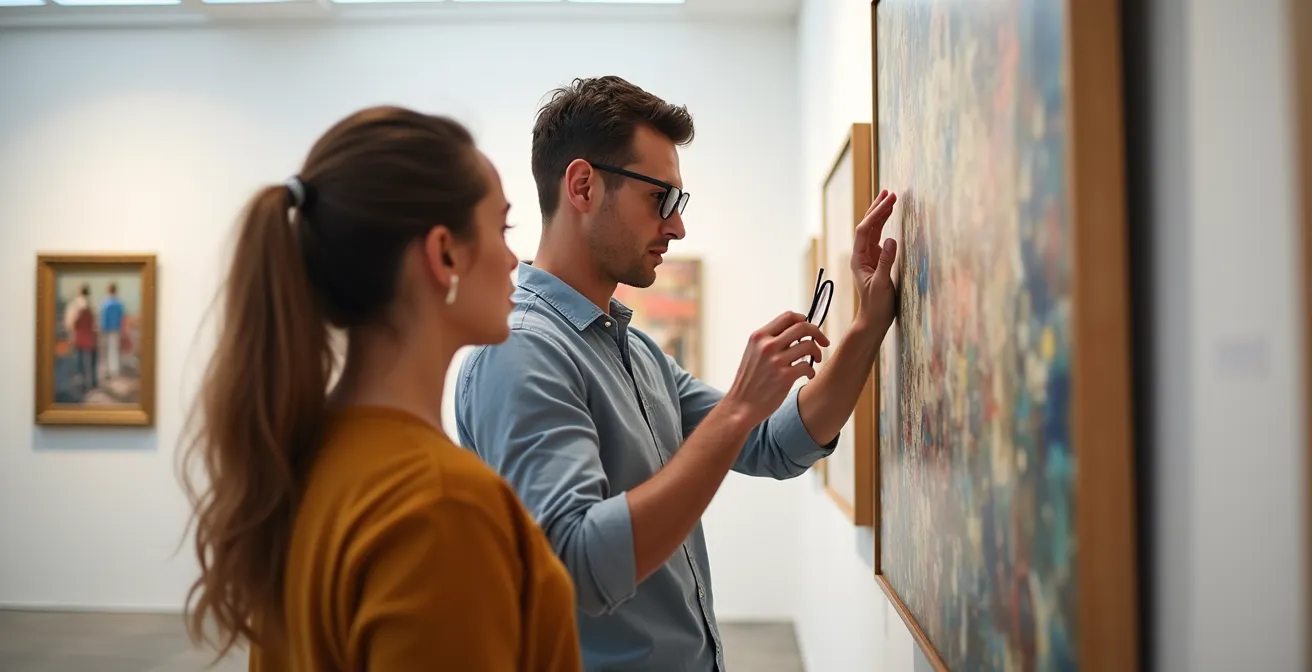
Buying your first artwork isn’t about “just buying what you love”; it’s about learning to distinguish authentic artistic intent from mass-market decoration.
- True value is found in an artist’s career trajectory and craftsmanship, not just aesthetics.
- Hidden costs (like buyer’s premiums) and a lack of provenance are the biggest financial traps for new collectors.
Recommendation: Shift your focus from “Is it pretty?” to “Does this piece have a story and a future?”
Entering the art market for the first time can feel like stepping into a foreign country without a map. You are surrounded by unspoken rules, opaque pricing, and the persistent fear of making a costly mistake. For many aspiring collectors, the intimidation of the gallery scene and the worry of overpaying for what amounts to little more than decoration can be paralyzing. The common advice, “buy what you love,” while well-intentioned, is dangerously incomplete. It fails to arm you against the very real risks of a market where value is not always visible to the untrained eye.
This approach leaves you vulnerable to purchasing market-driven decor that mimics the style of fine art but lacks its most critical component: artistic intent. The true challenge isn’t finding something aesthetically pleasing; it’s learning to identify the markers of genuine creativity, technical skill, and a credible career path. But what if the key wasn’t about developing an infallible “eye” overnight, but rather adopting a strategic framework? What if you could learn to assess an artwork not just on its visual appeal, but on the strength of its story, its creator, and its place in the wider art world?
This guide demystifies that process. We will move beyond the platitudes to provide a clear, actionable framework for your first acquisition. We will explore how to vet an artist, understand the real costs involved, and distinguish a smart investment from an expensive mistake. By shifting your perspective from that of a consumer to that of a collector, you can navigate the market with confidence, ensuring your first purchase is not only a piece you love but one with lasting significance and value.
To guide you through this journey, this article breaks down the essential knowledge every new collector needs. From understanding the stability of the high-end market to spotting the next generation of talent, each section is designed to build your confidence and competence.
Summary: A New Collector’s Guide to Acquiring Art with Intelligence
- Why “Blue Chip” Art Outperforms the S&P 500 During Inflationary Periods?
- How to Bid at an Art Auction Without accidentally Spend More Than Your Limit?
- Limited Edition Print vs. Original: Which Is the Smarter Buy for a $1,000 Budget?
- The Provenance Gap That Makes Buying Art on eBay Risky
- When to Buy Emerging Artists: Spotting Talent Before Prices Spike
- Why Keeping More Than $10k in a Savings Account Is Costing You Money Daily?
- Why a Handmade Ceramic Mug Costs $45 Instead of $5?
- How to Distinguish True Craftsmanship From Mass-Produced “Handmade” Goods?
Why “Blue Chip” Art Outperforms the S&P 500 During Inflationary Periods?
Before diving into your first purchase, it’s crucial to understand why fine art is considered a serious asset class. In times of economic volatility, tangible assets with finite supply often become safe havens for capital. Blue-chip art—works by historically significant, globally recognized artists like Warhol or Picasso—exemplifies this principle. Unlike stocks or bonds, their value is not directly tied to the daily fluctuations of the financial markets. This resilience is a key reason why seasoned collectors view art as a vital component of a diversified portfolio.
During inflationary periods, when the purchasing power of cash erodes, assets like blue-chip art tend to hold or even increase their value. They function as a store of wealth that is insulated from many traditional economic pressures. Data consistently supports this trend; for instance, the most sought-after segment of the art market has shown remarkable stability. According to Artprice data, blue-chip art has delivered an average annual return of 8.9% over the last two decades, demonstrating consistent, long-term growth.
A prime example of this stability occurred in 2022, a year marked by significant economic headwinds. While the broader art market and traditional financial markets saw declines, the top tier of artists demonstrated its unique resilience. An analysis showed that while the S&P 500 index fell by over 19%, the Artprice100 index tracking blue-chip artists actually posted a modest gain. This proves that while the wider market may fluctuate, investment-grade art created by artists with established historical importance maintains its value, acting as a buffer against widespread economic uncertainty.
How to Bid at an Art Auction Without accidentally Spend More Than Your Limit?
The auction room, with its rapid-fire bidding and palpable tension, is one of the most intimidating environments for a new collector. The thrill of the chase can easily lead to emotional decisions and the dreaded “winner’s curse”—the feeling of regret after realizing you’ve overpaid. The key to avoiding this is to enter the auction not with a vague budget, but with a calculated, non-negotiable “walk-away” price. This figure is not just the hammer price; it must account for all the additional costs that are part of the final invoice.
The most significant of these is the buyer’s premium, a percentage of the hammer price that the auction house charges the winner. This premium can be as high as 25% or more, drastically increasing your total cost. On top of that, you must factor in local sales tax or VAT, as well as potential costs for shipping and insurance. Ignoring these additions is the most common mistake new bidders make. As experts from The Decision Lab note, the psychology of the auction room can work against you.
In these emotional and overwhelming situations, it can be difficult to make rational decisions about an item’s value, and people often fall victim to the winner’s curse.
– The Decision Lab, Psychology of the Winner’s Curse
To combat this, you must do the math before the first bid is even called. By calculating your maximum bid *after* subtracting all potential fees from your absolute maximum budget, you create a rational guardrail against emotional overspending. This preparation transforms you from a passive participant into a strategic bidder.
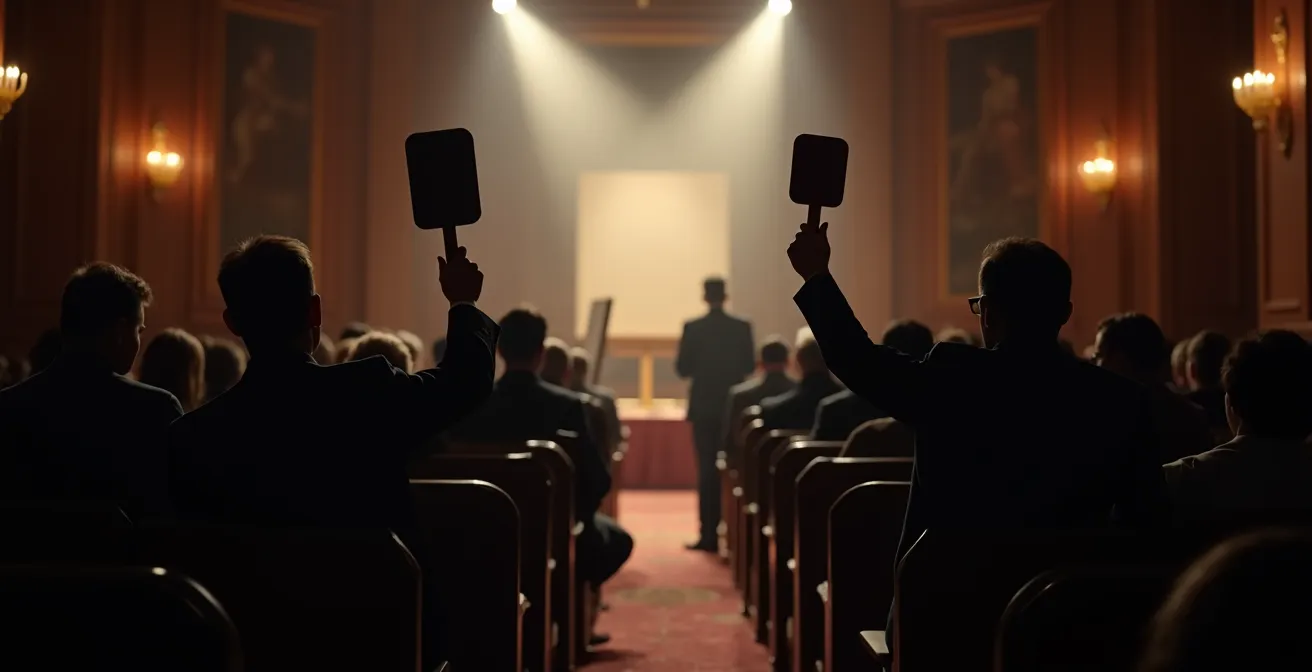
Your Action Plan: Calculating Your True Walk-Away Price
- Determine your absolute maximum budget for the artwork, including all fees.
- Research the auction house’s buyer’s premium percentage (typically 15-25%) and subtract it from your total budget.
- Calculate and subtract the applicable sales tax or VAT for your location from the remaining amount.
- Estimate and subtract shipping and insurance costs, which often run 2-5% of the hammer price.
- The final resulting amount is your maximum hammer price—the highest you should bid. Do not exceed it.
Limited Edition Print vs. Original: Which Is the Smarter Buy for a $1,000 Budget?
For a new collector with a modest budget, the choice between an original work by an unknown artist and a limited edition print by an established name is a central dilemma. There is no single right answer, as the “smarter” buy depends entirely on your goals: are you seeking the unique touch of an artist’s hand, or the lower-risk value associated with a recognized name? With a budget around $1,000, you are positioned at a fascinating crossroads in the market, where both options are viable but offer different trade-offs in terms of risk, authentication, and long-term value.
An original work from an emerging artist offers the allure of the unique—the direct connection to the creator through individual brushstrokes and texture. The potential for a high return on investment is significant if the artist’s career takes off, but the risk is equally high. A limited edition print, on the other hand, allows you to acquire a piece by a blue-chip or mid-career artist whose market is already established. While not a one-of-a-kind piece, its value is supported by the artist’s reputation and the controlled scarcity of the edition.
When evaluating prints, the edition size is paramount; a print from an edition of 50 is far more valuable than one from an edition of 500. Furthermore, experts note that the earliest prints in a run are often more coveted by collectors, meaning lower edition numbers can command higher prices. Authentication for prints relies on the edition number, the artist’s signature, and sometimes a publisher’s chop mark or a Certificate of Authenticity (COA).
The following table, based on insights from art market experts, breaks down the key considerations to help you make an informed decision aligned with your collecting strategy.
| Factor | Limited Edition Print | Original Work |
|---|---|---|
| Typical Price Range ($1,000 budget) | High-quality prints from established artists | Emerging artist originals |
| Authentication | Edition number, publisher’s chop mark, COA | Direct from artist/gallery provenance |
| Investment Risk | Lower risk, established artist name | Higher risk, higher potential upside |
| Physical Connection | Printing technique visible (lithograph, etching) | Unique brushstrokes, texture, artist’s hand |
| Edition Impact on Value | Smaller editions (under 100) more valuable | One-of-a-kind, no dilution |
The Provenance Gap That Makes Buying Art on eBay Risky
In the digital age, it’s tempting to browse for art on platforms like eBay, where “deals” seem abundant. However, these open marketplaces present the single greatest risk for a new collector: the provenance gap. Provenance is an artwork’s chain of ownership—a documented history that traces the piece back to the artist’s studio. It is the ultimate proof of authenticity and a cornerstone of an artwork’s value. Reputable galleries and auction houses meticulously document provenance, but on peer-to-peer platforms, this documentation is often missing, incomplete, or outright forged.
Without solid provenance, you have no verifiable way of knowing if a work is genuine. You could be buying a clever fake, a misattributed piece, or a print from a massive, open edition being passed off as a rare collectible. This is where the concept of a catalogue raisonné becomes critical. A catalogue raisonné is a comprehensive, scholarly compilation of all known works by an artist. For major artists, its inclusion is the gold standard of authentication.
Case Study: The Warhol Authentication Standard
The best method for verifying an Andy Warhol print is checking its inclusion in the official Andy Warhol Catalogue Raisonné. This multi-volume publication documents his known works across all media. Its scholarly rigor provides an essential layer of validation that a simple signature or a seller’s claim cannot match. As highlighted by art brokerage experts, while the catalogue is the ultimate reference, the artist’s foundation no longer issues individual certificates, making this documented history even more critical for establishing authenticity and avoiding forgeries that are rampant on the open market.
To protect yourself, you must become a digital detective. Before considering any online purchase from an unvetted source, a rigorous due diligence process is non-negotiable. This involves cross-referencing information across multiple trusted platforms and demanding documentation that closes the provenance gap.
- Use reverse image search to check for fakes or misattributions.
- Verify the artist’s CV (curriculum vitae) for legitimate gallery representation and press.
- Cross-reference the work on reputable platforms like Artsy or established gallery websites.
- Request documentation of email correspondence with the gallery or artist.
- For modern works, look for blockchain-based certificates of authenticity.
- Check if the work is listed in the artist’s catalogue raisonné, if one exists.
When to Buy Emerging Artists: Spotting Talent Before Prices Spike
Acquiring work from an emerging artist offers the highest potential reward for a collector. It’s an opportunity to support a creative career from its early stages and, if your assessment is correct, see the value of your piece grow exponentially. However, this is not a game of pure luck. Spotting talent is a skill built on research, observation, and direct engagement with the art community. The goal is to identify artists who possess not only raw talent but also the drive, academic backing, and conceptual rigor that signal a sustainable career—in other words, artists with clear artistic intent and a promising career trajectory.
The market for new talent is vibrant; in a recent year, a major art market report noted a substantial influx of fresh voices, with 1,343 artists making their debut at major auction houses and achieving an impressive sell-through rate. This indicates strong collector demand for new work. So, how do you find these artists before they reach the auction block? The key is to look at the incubators of talent: prestigious art schools and graduate degree shows. As Katherine Oliver of the Royal Academy of Arts advises, this is where you can connect with the source.

Keep an eye on graduates from the major art schools… In two or three years they could be represented by a commercial gallery and their pieces may rocket in value, so buying before that point is a savvy move. Go to graduate shows, meet artists and talk to them about their work… By building relationships with artists, you become their personal client and will get to hear about new works first.
– Katherine Oliver, Royal Academy of Arts
This direct engagement is your best tool. Visiting an artist’s studio, understanding their process, and hearing them articulate their vision gives you insights that a JPEG on a website never can. You are not just buying a painting; you are investing in a person and their developing career. Look for artists who are building a coherent body of work, who can speak intelligently about their influences and goals, and who are starting to gain recognition through group shows or small awards. This is how you spot true potential before the market does.
Why Keeping More Than $10k in a Savings Account Is Costing You Money Daily?
In an inflationary environment, holding a large amount of cash in a standard savings account is equivalent to actively losing money. The low interest rates offered by banks simply cannot keep pace with the rate at which inflation erodes the purchasing power of your dollars. For aspiring collectors, this reality presents a powerful argument for reallocating a portion of those savings into tangible assets that have a history of holding their value. As established by Maddox Gallery, “As inflation and economic uncertainty continue to challenge traditional markets, fine art has asserted itself as a resilient asset class.”
This doesn’t mean you should drain your emergency fund. Rather, it suggests a strategic shift in thinking about capital beyond your immediate needs. That $10,000 sitting in savings could be the foundation of a thoughtful, diversified art collection that not only provides aesthetic enjoyment but also acts as a long-term store of value. The key is to approach it with a plan, allocating your funds strategically to balance risk and opportunity. A smart entry strategy doesn’t involve putting all your money into a single high-risk piece.
Instead, consider a diversified approach. You might allocate a portion to a lower-risk blue-chip print, another to a higher-potential original from a vetted emerging artist, and even a smaller amount to fractional art investment platforms that allow you to own shares in masterpieces. A well-structured entry strategy for a $10,000 budget could look something like this:
| Allocation | Investment Type | Risk Level | Example |
|---|---|---|---|
| $4,000 (40%) | Safe Entry – Established Artist Print | Low | Limited edition print by blue-chip artist |
| $3,500 (35%) | Growth Entry – Emerging Artist Original | Medium-High | Original painting from vetted gallery |
| $1,500 (15%) | Fractional Shares Platform | Medium | Masterworks or similar platform shares |
| $1,000 (10%) | Education & Access | None | Art fair tickets, books, gallery memberships |
Why a Handmade Ceramic Mug Costs $45 Instead of $5?
To truly understand the value of an original artwork, it is helpful to first deconstruct the price of a handmade object. The question of why a handcrafted ceramic mug costs $45 while a mass-produced one costs $5 goes to the heart of what you are paying for: not just a functional object, but skill, time, and artistic vision. This same logic applies, on a larger scale, to a painting or sculpture. The price tag on an artwork is not an arbitrary number; it is a complex calculation that reflects the artist’s entire professional ecosystem.
The final price of an artwork encompasses a wide range of tangible and intangible factors. The cost of materials—canvas, professional-grade paints, and framing—is just the starting point. It must also cover the artist’s studio overhead, including rent and utilities. A significant portion of the price, often 50%, goes to the gallery commission, which pays for the gallery’s work in marketing the artist, hosting exhibitions, and building their career. Most importantly, the price reflects the artist’s time and the scarcity of their output. A single painting can take weeks or months of dedicated labor.
Ultimately, a large part of the value is tied to the artist’s brand equity. This is built over years through their education (a Master of Fine Arts degree from a top school), their exhibition history, any awards or grants they have received, and inclusion in prestigious collections. When you buy a work of art, you are paying for all of these components. This is why a piece’s value tends to remain stable or increase over time; its worth is independent of most external market events and is instead tied to the artist’s unique, non-replicable career.
Deconstructing the Price: What Are You Paying For?
- Materials Cost: Canvas, paint, and framing materials typically account for 10-20% of the final price.
- Studio Overhead: The costs of maintaining a professional workspace, including rent, utilities, and equipment.
- Gallery Commission: Often 50% of the sale price, which covers representation, marketing, and exhibition costs.
- Artist’s Brand Equity: The value built through education (MFA programs), exhibition history, and awards.
- Time Investment: The hours, weeks, or even months of skilled labor invested in creating a single piece.
- Scarcity Value: An individual artist has a limited production capacity, making each work inherently scarce.
Key Takeaways
- Focus on “artistic intent” (skill, vision, career trajectory) over pure aesthetics to avoid buying mass-market decor.
- Always calculate the “walk-away” price for an auction by subtracting the buyer’s premium and taxes from your total budget *before* you bid.
- For a sub-$1,000 budget, an established artist’s print offers lower risk, while an emerging artist’s original offers higher potential reward.
How to Distinguish True Craftsmanship From Mass-Produced “Handmade” Goods?
You now understand the components of price and the importance of provenance. The final and most crucial skill is synthesizing this knowledge to distinguish a genuine work of art from a piece of market-driven decoration. The latter is designed to match current interior design trends; it is created to be commercially appealing and easily replicable. An artist-driven work, by contrast, is an expression of a unique vision. It is part of a coherent body of work and is driven by the artist’s desire to explore a concept or master a technique, not simply to fill a space on a wall.
This distinction is the core of confident collecting. It’s the filter through which you should view every potential acquisition. The good news is that there are tangible clues. A physical inspection can reveal much: look for the texture of real brushstrokes, the slight build-up of paint on the edges of a canvas, and the small, unique imperfections that are the signature of a human hand. A mass-produced print or “hand-painted” factory reproduction will often feel flat and uniform, with clean, sharp edges where the image simply stops.
This framework is your ultimate defense against getting ripped off. By training your eye to look for these signals of intent and authenticity, you move beyond the surface-level appeal and begin to see the art for what it is. This is why high-net-worth collectors are increasingly allocating more of their wealth to art; they understand this distinction and are investing in assets with real, defensible value. By adopting their mindset, you can ensure your first purchase is the start of a meaningful collection, not a design choice you’ll regret.
The table below summarizes the critical differences between a work of true artistic intent and a decorative object masquerading as art.
| Criteria | Artist-Driven Work | Market-Driven Decor |
|---|---|---|
| Artist Identity | Clear artist with documented CV and exhibition history | Anonymous or corporate production |
| Conceptual Series | Part of coherent body of work with artistic statement | Designed to match interior trends |
| Physical Inspection | Textured brushstrokes, paint on canvas edges, unique imperfections | Flat printed surface, clean edges, uniform appearance |
| Authentication | Gallery provenance, artist signature, catalogue inclusion | Mass production codes, retail barcodes |
| Intent | Expression of unique vision or mastery of technique | Commercial replication of popular styles |
Now that you have the framework to distinguish real art from decoration, the next logical step is to start exploring with confidence. Begin by visiting graduate shows, following galleries online, and applying this critical lens to every work you see. Your journey as a collector starts today.