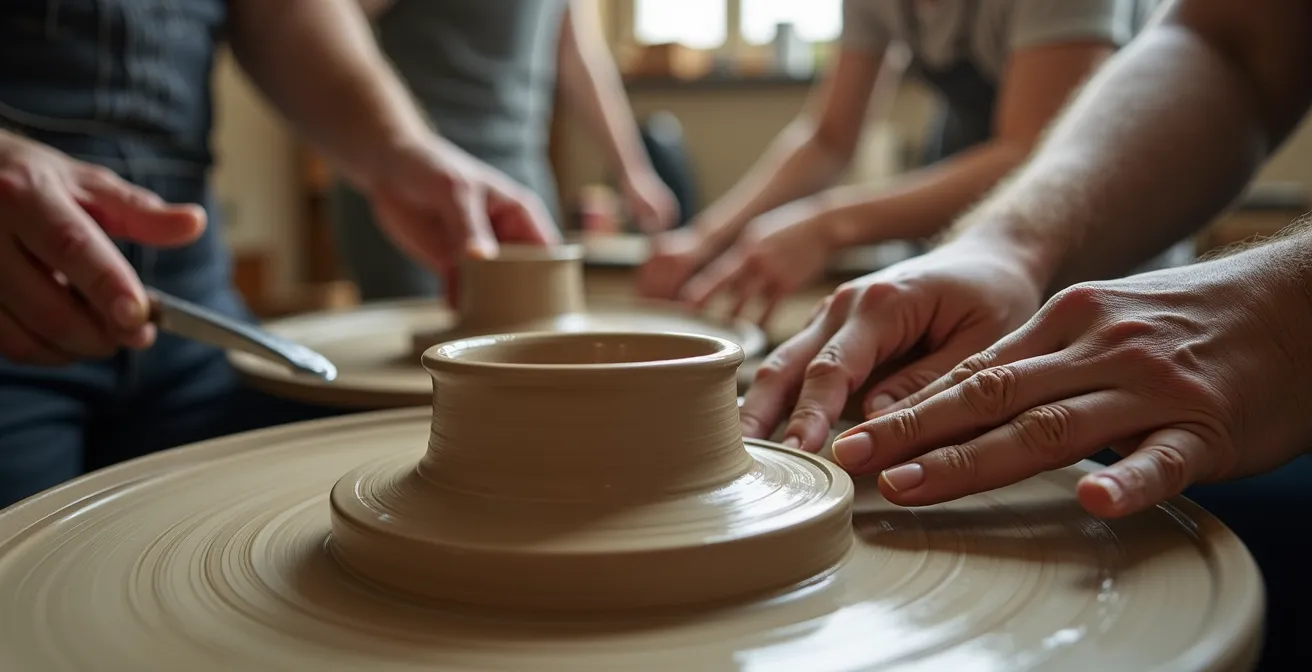
The best craft workshops aren’t defined by the price or the instructor’s perfect portfolio, but by clear pedagogical signals that prioritize your learning process over a single perfect product.
- Vet instructors by examining their students’ progress and their willingness to share their own mistakes.
- Choose a craft based on its learning curve and your tolerance for initial failure—the “frustration cliff.”
Recommendation: Before booking, use the instructor audit in this guide to assess if a workshop is designed for genuine skill-building or just for entertainment.
There’s a growing desire among adults to step away from screens and create something tangible with their own hands. You’ve seen the ads: a sun-drenched pottery studio, a cozy knitting circle, a focused woodworking bench. The promise is alluring—a creative outlet, a new hobby, maybe even a new passion. Yet, this excitement is often shadowed by a nagging fear: Am I about to spend hundreds of dollars on a glorified “wine and paint” night that leaves me with a lopsided pot and no actual skills to show for it?
The common advice is to read reviews or look at the instructor’s beautiful finished work. But this approach is flawed. Positive reviews can reflect a fun social experience rather than a solid educational one, and a masterful artist is not always a masterful teacher. The market is saturated with “creative experiences” designed for a fun afternoon, which is perfectly fine if that’s your goal. But if you want to acquire a genuine, transferable skill you can continue to develop on your own, you need a different strategy.
What if the true measure of a great workshop isn’t in the instructor’s successes, but in how they prepare you to handle your own failures? This guide shifts the focus from the final product to the teaching process itself. It will provide you with a framework to think like an educator, enabling you to identify the crucial pedagogical signals that separate a fleeting experience from a transformative learning opportunity. We will explore how to vet an instructor’s teaching style, realistically assess a craft’s learning curve, and build a sustainable creative practice long after the workshop ends.
This article provides a comprehensive framework for selecting a workshop that truly delivers on its promise of skill acquisition. We will break down everything from the cognitive benefits of hands-on hobbies to the practical steps for integrating creativity into your life.
Summary: A Strategic Guide to Choosing Your Next Craft Workshop
- Why Tactile Hobbies Improve Cognitive Function in Adults Over 30?
- How to Vet an Instructor’s Portfolio Before Booking a Weekend Intensive?
- Pottery vs. Woodworking: Which Hobby Has a Steeper Learning Curve for Beginners?
- The Wrist Injury That Plagues New Knitters and How to Avoid It
- How to Carve Out 3 Hours a Week for Creativity in a Busy Schedule?
- Workshops vs. Mentorship: Which Training Method Sticks for Tech Skills?
- The “Course Hoarding” Habit That Stops You From Applying What You Learn
- How to Leverage Online Courses to Pivot Your Career Without a New Degree?
Why Tactile Hobbies Improve Cognitive Function in Adults Over 30?
The drive to learn a craft is more than just a desire for a new hobby; it’s a fundamental cognitive need. Engaging in tactile, skill-based activities like pottery, knitting, or woodworking is a powerful way to enhance brain health, particularly for adults. In fact, compelling research reveals a 45% lower risk of developing mild cognitive impairment in individuals who regularly participate in arts and crafts. This isn’t just about “keeping busy”; it’s about actively building a more resilient brain.
The magic happens at a neurological level. When you learn a new physical skill, you are challenging your brain to form new neural pathways. This process, known as neuroplasticity, is the brain’s ability to reorganize itself by forming new connections. A groundbreaking 2024 study on the effects of visual arts practice documented structural brain changes and enhanced functional connectivity in adults after just 10 weeks. This demonstrates that creative engagement is not passive entertainment; it’s a workout for your brain that improves psychological resilience and adaptability.
Choosing a workshop, therefore, is an investment in your long-term cognitive vitality. The focused attention required to center clay on a wheel or make a precise cut in wood activates multiple brain regions simultaneously—coordinating motor skills, spatial reasoning, and problem-solving. This creates a state of “flow” that is not only meditative but also highly constructive for your brain’s architecture. The skill you learn is not just in your hands; it’s etched into your neural network.
How to Vet an Instructor’s Portfolio Before Booking a Weekend Intensive?
The single most important factor in a workshop’s success is the instructor. However, vetting a teacher goes far beyond admiring their personal work. A stunning portfolio only proves they are a good artist, not a good educator. To find a true teacher, you must look for pedagogical signals—clues that their focus is on your development, not their own showcase. The best instructors build a learning scaffold that supports you as you climb the initial learning curve.
As veteran workshop teacher Susan Yeates notes, the mindset of a great teacher is rooted in empathy for the learning process. In her “Magenta Sky Arts and Crafts Workshop Teaching Guide,” she explains:
A great instructor isn’t afraid to show their own mistakes, experiments, and failed projects. This demonstrates empathy for the beginner’s journey and a problem-solving mindset.
– Susan Yeates, Magenta Sky Arts and Crafts Workshop Teaching Guide
This is a critical insight. Look for instructors who share their “bloopers” or explain how they overcame challenges. This transparency is a powerful indicator that they are equipped to guide you through your own inevitable mistakes. Their curriculum should be structured to build skills progressively, providing templates, checklists, and clear explanations of the “why” behind each technique, not just the “how.”
Your Pre-Booking Instructor Audit: 5 Points to Verify
- Student Work vs. Instructor Work: Prioritize reviewing portfolios of past students. Do they show a clear progression of skill, or does every project look identical and “perfect” (a sign of over-involved teaching)?
- The “Mistake” Litmus Test: Scour their blog, social media, or videos. Do they ever share their own failed projects or discuss how they troubleshoot problems? This signals a focus on process, not just perfection.
- Teaching in Action: Look for videos or detailed blog posts where they are actively teaching. Do they explain the “why” behind a technique, or just demonstrate the “how”? Great teachers articulate the principles.
- Structured Support Materials: Does the workshop description mention providing templates, reference documents, or practical checklists? This demonstrates a structured approach to learning and gives you tools to use after the class.
- Authentic Experience: Verify their teaching experience. A decade of personal practice is different from a decade of teaching. Look for testimonials that specifically mention the instructor’s ability to explain complex concepts clearly.
Pottery vs. Woodworking: Which Hobby Has a Steeper Learning Curve for Beginners?
Choosing the right craft is as much about managing your own expectations as it is about interest. Both pottery and woodworking offer immense satisfaction, but their learning curves are vastly different. Understanding these differences can prevent early frustration and help you select a hobby that aligns with your personality and resources. One craft involves a steep initial challenge, while the other offers a more gradual path to success.
The image below visually contrasts the distinct environments and toolsets of these two foundational crafts, hinting at their different demands.
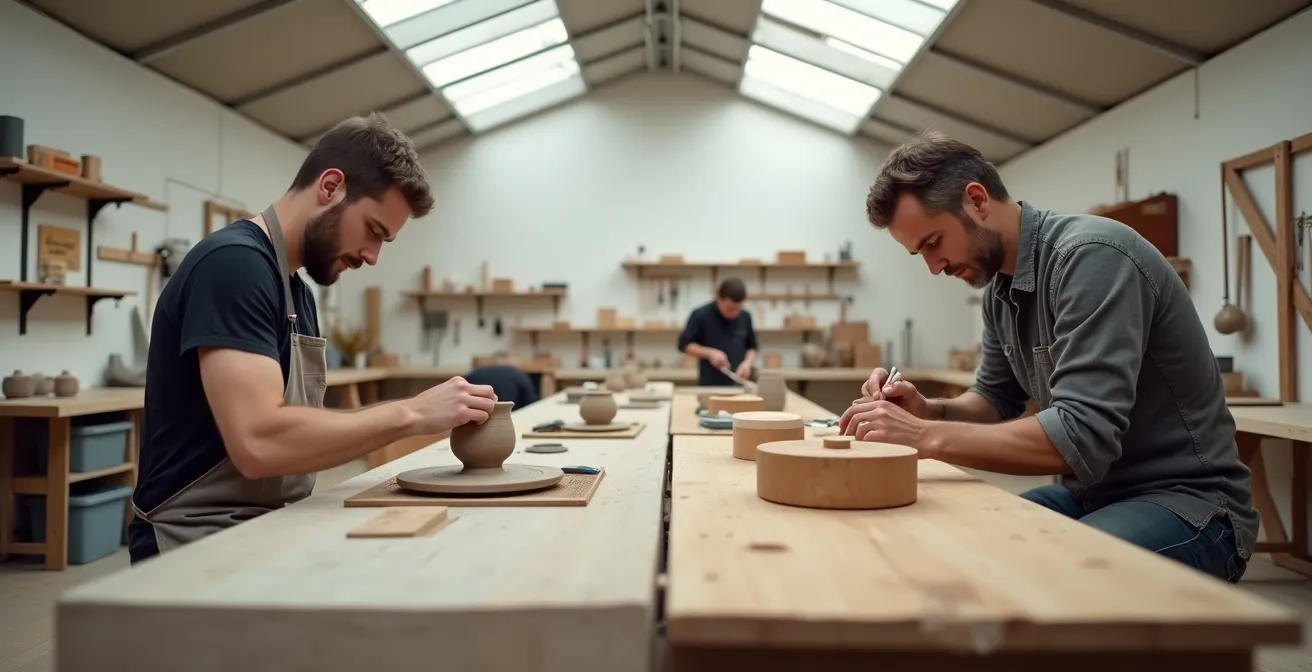
Pottery, especially wheel-throwing, is notorious for its high initial “frustration cliff.” For weeks, your primary output might be collapsed, wobbly cylinders. It demands core strength, posture control, and a patient “feel” for the clay that can’t be rushed. Woodworking, particularly with hand tools, often presents a more linear, “slow burn” learning process. Your first project might be simple, but it will likely be functional. Success is more incremental and less prone to catastrophic failure.
This comparison from Kieffer Ceramics highlights the key differences in investment and ergonomic challenges. An analysis of workshop ergonomics shows that the physical demands and cost to practice independently vary significantly.
| Aspect | Pottery | Woodworking |
|---|---|---|
| Initial Failure Rate | High ‘frustration cliff’ – frequent early failures | Moderate ‘slow burn’ – gradual skill building |
| Physical Requirements | Core strength, posture control for wheel work | Hand/wrist stability, fine motor control |
| Cost to Practice Independently | High – requires kiln access ($500-2000/year) | Moderate – basic hand tools sufficient ($200-500) |
| Time to First Success | 4-8 weeks for basic vessels | 2-3 weeks for simple projects |
| Ergonomic Challenges | Back strain, wrist hyperextension | Repetitive strain, grip fatigue |
The Wrist Injury That Plagues New Knitters and How to Avoid It
Knitting is often perceived as a gentle, relaxing hobby, but for many enthusiastic beginners, it can lead to a surprisingly common and painful problem: repetitive strain injury (RSI) in the wrists. This issue, often dubbed “knitter’s wrist,” arises from poor ergonomics, excessive tension, and long, uninterrupted sessions. Ignoring the physical mechanics of a craft can stop a budding passion in its tracks, turning a source of joy into a source of pain.
The root of the problem lies in improper hand and wrist positioning. Many new knitters hold their needles with a tense grip, bend their wrists at sharp angles, or make large, inefficient movements. This puts undue strain on the delicate tendons and nerves running through the carpal tunnel. The key to prevention is cultivating a relaxed, neutral wrist posture from the very beginning, as demonstrated by the proper ergonomic grip in the image below.
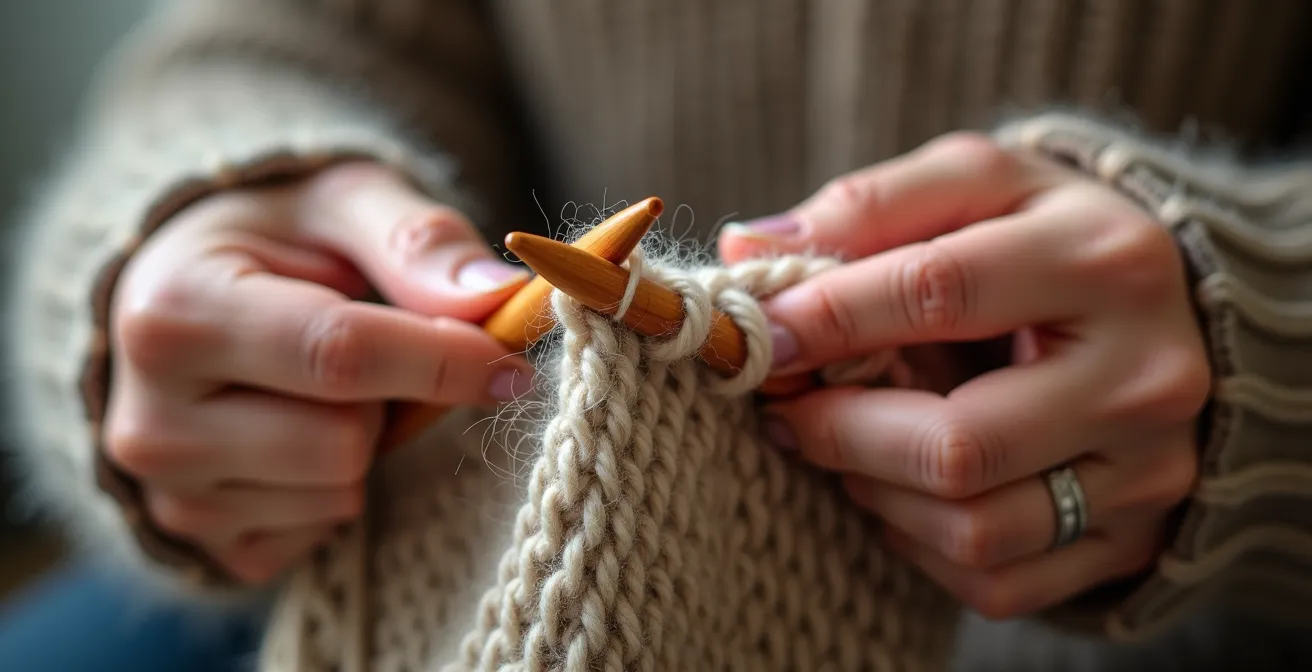
Fortunately, these injuries are highly preventable with the right knowledge. Physical therapist and ergonomic specialist Carson Demers developed a comprehensive ergonomic approach for knitters to address this exact issue. In a study documented on his platform, Ergo I-Knit, he found that a combination of proper wrist alignment, varying knitting styles (such as switching between English and Continental methods to use different muscles), and taking regular 5-minute stretching breaks reduced injury rates by over 60% among workshop participants. This proves that sustainable practice is a skill in itself, just as important as mastering a new stitch.
How to Carve Out 3 Hours a Week for Creativity in a Busy Schedule?
The most common barrier to starting a new hobby isn’t money or a lack of ideas; it’s time. In a packed schedule, finding a consistent three-hour block for a creative pursuit can feel impossible. However, the key isn’t to magically find more time, but to strategically integrate creativity into the time you already have. This requires a shift in mindset from “making time” to “habit stacking” and optimizing small windows of opportunity.
Instead of waiting for the perfect, uninterrupted afternoon, break your practice down into manageable “task sprints.” Many crafts are more portable and divisible than you might think. A small weaving loom, a sketchbook, or a knitting project can easily fit into a bag, ready for a 15-minute session while you wait for an appointment or during your lunch break. The goal is to lower the barrier to entry so significantly that starting feels effortless. Keeping all your materials in a “project bag” eliminates setup time, one of the biggest psychological hurdles to getting started.
This approach of consistent, targeted practice is highly effective. Research on workshop effectiveness shows a 78% success rate for targeted skill workshops, demonstrating that focused effort yields real results. To make this happen, consider these strategies:
- Habit Stacking: Anchor your new creative habit to an existing one. For example, commit to 10 minutes of sketching while your morning coffee brews.
- Schedule It Like a “Health Appointment”: Block out creative time in your calendar with the same seriousness you would a doctor’s visit. This reframes it from a leisure activity to a necessary part of your well-being.
- Create a Micro-Workspace: Dedicate a small corner of your home to your craft that is always ready to go. Even a small tray on a side table can serve as a permanent station that requires zero setup.
- Use “Dead Time”: Utilize commute time or waiting periods to plan your next project, watch a technique video, or organize your materials.
Workshops vs. Mentorship: Which Training Method Sticks for Tech Skills?
Once you’ve mastered the fundamentals of a craft, you’ll face a new choice for continued growth: should you take another advanced workshop or seek out a mentorship? While both paths lead to improvement, they serve distinctly different purposes. Understanding this distinction is key to investing your time and money wisely, whether your “tech skills” involve coding an API or mastering a complex glazing technique.
A workshop is an intensive, structured environment ideal for learning foundational rules and new, specific techniques quickly. It’s like a bootcamp for a particular skill set. You benefit from a condensed curriculum and the shared energy of a group. A mentorship, on the other hand, is a long-term, personalized relationship focused on developing your unique style and honing your problem-solving abilities. It’s less about learning a new “API” and more about getting personalized feedback to debug your process and refine your artistic voice.
The best choice depends entirely on your current goal. Are you looking to acquire a brand-new skill from scratch? A workshop is almost always the most efficient starting point. Have you hit a plateau and need guidance on developing your personal style or tackling a large-scale project? A mentor can provide the tailored advice a group class cannot. As this comparative analysis of teaching formats suggests, the context of your learning journey determines the most effective method.
| Aspect | Workshops | Mentorship |
|---|---|---|
| Learning Style | Structured API/foundational rules | Personalized debugging and style development |
| Time Investment | Intensive 2-3 day sessions | Ongoing weekly/monthly meetings |
| Cost | $200-800 per workshop | $50-200 per session or trade arrangement |
| Best For | Learning fundamentals quickly | Developing personal style and problem-solving |
| Community Access | Limited to workshop duration | Long-term network building |
The “Course Hoarding” Habit That Stops You From Applying What You Learn
In the age of endless online tutorials and craft kits, it’s easy to fall into a pernicious trap: course hoarding. This is the habit of endlessly collecting resources—buying online courses, saving tutorials, and pinning project ideas—without ever actually starting or finishing a project. The thrill of acquiring potential knowledge becomes a substitute for the challenging work of actual creation. This habit is the ultimate enemy of skill development, as it keeps you in a perpetual state of “getting ready to start.”
The psychological root of course hoarding is often a fear of imperfection. The pristine, potential-filled course feels safer than the messy reality of a half-finished, flawed project. To break this cycle, you must shift your focus from consumption to application. The goal is not to absorb all possible information before you begin, but to learn just enough to take the next step. This means embracing the “good enough” project and celebrating the process of learning, not just the final outcome.
Breaking this habit requires setting firm boundaries and creating a system for immediate application. Here are five actionable strategies to stop hoarding and start creating:
- Implement the One Project Rule: Forbid yourself from browsing or buying any new courses or materials until you have completed one tangible, albeit imperfect, project from a course you already own.
- Set a Research Deadline: Give yourself a strict time limit for the planning phase (e.g., one week). Once the deadline hits, you must begin the physical act of creating, regardless of how “ready” you feel.
- Create a Technique Sampler: Instead of aiming for a masterpiece, create a small “sampler” that allows you to practice the core techniques from a course without the pressure of a large, final project.
- Document Your Learning: Shift your documentation focus from final results to work-in-progress. Take photos of your messy desk, your failed attempts, and your small wins. This celebrates the journey.
- Find an Accountability Partner: Share your work-in-progress with a trusted friend or an online community. The simple act of sharing creates a positive feedback loop and a sense of commitment.
Key Takeaways
- Genuine skill-building workshops prioritize the teaching process and student development over showcasing the instructor’s own perfect art.
- Vetting an instructor involves looking for “pedagogical signals” like their willingness to share mistakes and the availability of structured support materials.
- Choosing a craft should involve a realistic assessment of its “frustration cliff” and ergonomic demands to ensure long-term, injury-free practice.
How to Leverage Online Courses to Pivot Your Career Without a New Degree?
In today’s economy, the idea that a career pivot requires a new, expensive degree is becoming obsolete. A well-chosen series of craft or skills-based courses, combined with consistent application and public sharing, can create a viable pathway to a new profession. This approach isn’t about collecting certificates; it’s about building a public portfolio of demonstrable skill and leveraging modern platforms to build an audience and a business.
The story of Johnny Brooke is a powerful testament to this model. As detailed in a profile by Global Industrial, Johnny successfully transitioned from a traditional career to a full-time content creator. He achieved this by launching the Crafted Workshop YouTube channel and consistently producing detailed project videos. By sharing his woodworking process, he not only honed his own skills but also built a community.
Case Study: Johnny Brooke’s Career Pivot Through Craft Content
Johnny Brooke of the Crafted Workshop YouTube channel grew his audience to over 100,000 subscribers by producing 3-4 detailed project videos per month. This consistent output of skill-sharing content allowed him to build a viable business model through sponsorships and ad revenue, demonstrating how a craft learned through non-traditional means can become a full-time career without formal credentials, as chronicled by Global Industrial.
The value of these learning experiences extends beyond the technical skills. As Dr. Rie Natalenko, author of “Share Your Skills,” points out, the network you build is just as valuable. She emphasizes, “The value isn’t just the skill, but the connections. The instructor and fellow students are your first network for collaborations, commissions, or finding spots at craft fairs.” This community becomes your initial support system and professional network, providing opportunities that a traditional degree path might not.
Your journey to a new skill—or even a new career—begins with a single, well-informed choice. Instead of passively browsing, take the first active step today. Use the “Pre-Booking Instructor Audit” from this guide to evaluate one local or online workshop you’ve been considering. This simple action will transform you from a consumer into a discerning learner, setting the foundation for a truly rewarding creative practice.