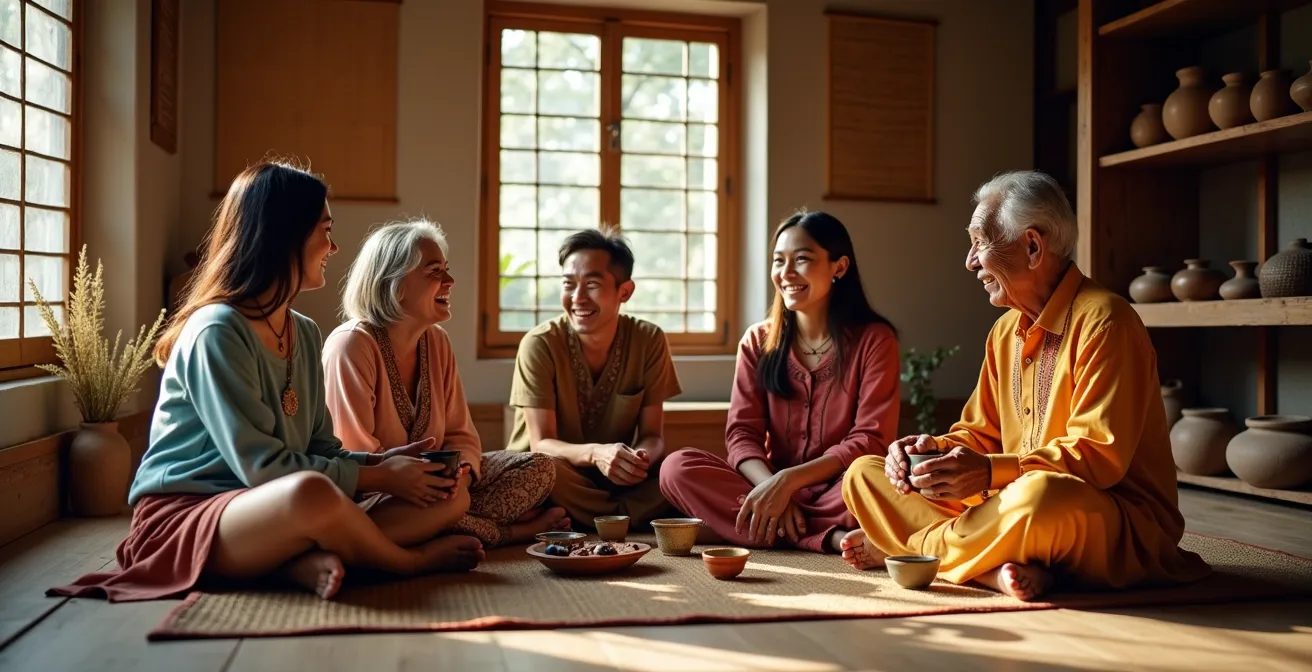
Authentic connection with locals isn’t about what you do, but how you perceive; it’s a shift from performative tourism to perceptive participation.
- The biggest barrier to connection is the fear of being intrusive, which stems from not understanding a culture’s unspoken social rules.
- Meaningful interactions are built on a foundation of observation, respectful communication (both verbal and non-verbal), and contributing to, rather than extracting from, the local culture.
Recommendation: Before your next trip, focus on learning to observe social cues and plan at least one activity centered on skill-sharing or generative participation, not just sightseeing.
You’ve felt that moment of hesitation. You’re in a bustling foreign market, a vibrant local festival, or a quiet side street, and you see an opportunity for connection—a friendly face, an interesting craft, a shared moment of humanity. But then the fear creeps in: Am I being intrusive? Will I seem like another clumsy, entitled tourist? This anxiety is the invisible wall that separates the traveler from the “textbook tourist,” the one who collects photos but never stories, who sees the sights but never gains insight.
For years, the conventional wisdom has been to “learn a few local phrases” or “get off the beaten path.” While well-intentioned, this advice often leads to performative actions rather than genuine connection. You say ‘hello’ in the local tongue but don’t understand the non-verbal response. You wander into a “local” neighborhood but feel more like an invader than a guest. The fundamental mistake is focusing on a checklist of actions instead of cultivating a mindset of deep observation and respect.
But what if the key wasn’t about trying harder to *do* what locals do, but about learning to *understand* the unspoken rules of their social world? What if you could transform your travel from a series of superficial encounters into a journey of perceptive participation? This guide is built on that very principle. It moves beyond the platitudes to give you a cultural anthropologist’s framework for seeing, listening, and engaging in a way that fosters respect and opens the door to the authentic connections you crave.
We will explore the subtle but powerful impact of body language, the art of learning just enough of a language to show vulnerability, and how to navigate the modern traveler’s dilemmas—from ethical photography to avoiding the ‘Instagram vs. Reality’ trap. This is your roadmap to becoming a traveler who doesn’t just visit a place, but truly experiences it.
Summary: How to Connect Authentically With Locals and Stop Being a “Textbook Tourist”
- Why Your Body Language Might Be Offending Locals in Southeast Asia?
- How to Learn 50 Essential Phrases in 2 Weeks Before Your Trip?
- Guided Tours vs. Solo Wandering: Which Yields Deeper Cultural Insights in Europe?
- The Souvenir Mistake That Disrespects Sacred Traditions in Indigenous Regions
- How to Attend Local Festivals Without Contributing to Overtourism Crowds?
- How to Ask for Photos of People Without Being Intrusive or Rude?
- The “Instagram vs. Reality” Shock That Disappoints Visitors at Major Landmarks
- How to Plan a Transformative Travel Itinerary That Skips the Tourist Traps?
Why Your Body Language Might Be Offending Locals in Southeast Asia?
The first step toward authentic connection has nothing to do with what you say; it’s about what your body communicates before you even open your mouth. In many Western cultures, communication is direct and explicit (low-context). We value firm handshakes, direct eye contact, and clear verbal statements. However, this can come across as aggressive or disrespectful in many other parts of the world. In fact, East Asian, Middle Eastern, and Latin American cultures predominantly rely on high-context communication, where meaning is conveyed through shared understanding, non-verbal cues, and social hierarchy.
Consider the traditional Thai ‘Wai’—a slight bow with palms pressed together. This single gesture conveys respect, greeting, and gratitude without a word spoken or a touch exchanged. It is a perfect example of high-context communication in action. Similarly, in many Southeast Asian cultures, maintaining a slightly lower eye level with an elder or a person of authority is a sign of respect, not submission. Presenting or receiving an object with both hands is a gesture of politeness, while pointing your feet at someone can be a grave insult.
The key isn’t to memorize a dictionary of gestures, but to engage in a process of cultural calibration. Upon arrival, your first task is to become an observer. Watch how people interact in cafes, on public transport, and in markets. Notice the personal space they keep, the volume of their voices, and how they show deference. Refraining from outward displays of strong emotion and using more suggestive, less directive language can also be crucial. By observing first, you adjust your own non-verbal dictionary, replacing your default settings with ones that show you are a respectful and perceptive guest, not an oblivious tourist.
How to Learn 50 Essential Phrases in 2 Weeks Before Your Trip?
Once you’ve begun to calibrate your non-verbal communication, you can add the next layer: language. The goal here is not fluency, but connection. Learning a few key phrases is a powerful signal of respect and a tool to break down social barriers. It shows you’ve invested time and effort, and it immediately changes your status from a passive consumer to an engaged participant. The most effective phrases are not just “hello” and “thank you,” but those that show vulnerability and invite interaction.
Phrases like, “This looks delicious, what is it called?” or “Could you teach me the right way to say…?” position the local as the expert and you as the curious student. This simple dynamic shift transforms a transactional encounter into a relational one. Instead of just buying a piece of fruit, you are creating a micro-moment of shared experience. It opens the door for conversation and a genuine smile that a translation app, devoid of human context and warmth, can never replicate.
The idea of learning a language can feel daunting, but consistency beats intensity. You don’t need hours of study; a focused 15 minutes a day can make a massive difference. The key is a structured approach that prioritizes practical, connection-building phrases over complex grammar. This turns language learning from a chore into an exciting part of your pre-trip ritual.
Your 15-Minute Daily Language Plan
- Spend 15 minutes daily with language learning apps (like Duolingo or Memrise) focusing on a core list of 20-30 key phrases related to greetings, food, and asking for help.
- Practice speaking the phrases out loud, even if just to yourself. Use online videos to check your pronunciation and get comfortable with the sounds.
- Focus on learning phrases that show vulnerability and curiosity, such as “How do you say…?” or “I am trying to learn.”
- Aim to use at least 5 of your new phrases on the first day of your trip to build confidence and make it a habit.
- Avoid relying solely on translation apps in social situations; their literal translations often miss crucial cultural context and prevent genuine interaction.
Guided Tours vs. Solo Wandering: Which Yields Deeper Cultural Insights in Europe?
A classic traveler’s dilemma pits the structured knowledge of a guided tour against the spontaneous discovery of solo wandering. The former promises efficiency and context; the latter offers freedom and the chance for serendipitous encounters. The truth is, both approaches have their merits, but the most profound cultural insights often come from a hybrid model. Relying solely on a large, generic tour can insulate you from the local environment, while pure solo wandering can lack the context needed to understand what you’re seeing.
The solution is to use guided experiences as a form of social scaffolding—a temporary structure that provides you with the tools and confidence to build your own connections later. Instead of a large bus tour, seek out hyper-specialized, small-group tours led by locals with deep expertise, like history students, local artists, or food bloggers. These experiences are not just about seeing sights; they are about learning to see *like a local*.

This approach provides the “cultural calibration session” needed to truly unlock a destination. After a few hours with an expert guide, you’ll not only know the location of hidden gems but also understand the local etiquette, current events, and rhythms of daily life. This foundation transforms your subsequent solo wandering from a blind stumble into an informed exploration, where you can make spontaneous discoveries with a newfound layer of understanding.
The Hybrid Strategy: A Cultural Calibration Session in Practice
Travelers who adopt a hybrid strategy often report the most rewarding experiences. For example, a visitor to Rome might hire an art history student for a three-hour tour of a specific neighborhood like Trastevere on their first day. The guide points out not just historical markers, but also explains the social significance of the local piazza, the best time to visit the market to see real residents, and the subtle codes of ordering coffee at the bar. For the rest of their trip, the traveler navigates Rome not as a stranger, but as someone with insider knowledge, leading to more confident and meaningful interactions with shopkeepers and residents.
The Souvenir Mistake That Disrespects Sacred Traditions in Indigenous Regions
The act of buying a souvenir can be one of the most fraught interactions a traveler has. Too often, it’s an extractive process where a mass-produced trinket is purchased with little thought to its origin or impact. This is especially problematic in Indigenous regions, where objects can hold deep spiritual and cultural significance. The biggest mistake is treating a souvenir as a mere object, forgetting that it is the end-product of a person’s skill, a community’s history, and sometimes, a sacred tradition.
To avoid this, we must shift our mindset from buying an object to investing in a story. A generative souvenir is one that contributes to the continuation of a cultural practice, supports an artisan directly, and carries a genuine narrative. An artisan explaining the centuries-old weaving technique behind a textile creates a powerful connection that transforms the object from a simple commodity into a cherished piece of a shared experience. Your purchase becomes a vote for the preservation of that skill.
A powerful tool for making ethical choices is the “Three Cs” framework: Creator, Context, and Contribution. Before you buy, ask yourself these questions. This simple audit forces you to slow down and consider the real value of what you are purchasing. Better yet, consider ephemeral or experiential souvenirs. Participating in a craft workshop, taking a cooking class, or buying spices directly from a farmer not only ensures your money supports the right people but also provides you with a skill and a memory—the most personal souvenirs of all.
To guide your purchases, use this ethical framework:
- Creator: Can you meet or at least know the name of the person who made it? Is there a direct line between you and the maker?
- Context: Do you understand the story, the materials, and the traditional use or meaning of the object?
- Contribution: Does the full price you pay go directly to supporting the creator and their community, or is it diluted through multiple resellers?
How to Attend Local Festivals Without Contributing to Overtourism Crowds?
Local festivals are a culture’s heart on full display—a vibrant, concentrated expression of its traditions, music, food, and social bonds. For a traveler, they offer a fast track to cultural immersion. Yet, the presence of too many passive observers can dilute the event’s authenticity, strain local resources, and make residents feel like they are performers in a tourist spectacle. The key to attending festivals respectfully is to shift your role from a spectator to a perceptive participant.
Participation doesn’t mean jumping into the center of a sacred dance. It means contributing to the event’s ecosystem in small, meaningful ways. Start by doing your research. Major festivals often have smaller, community-focused satellite events listed on municipal websites or in local forums. Attending these less-crowded gatherings provides a more intimate experience. Once there, engage with the event’s economy: buy food from official stalls run by community groups, purchase crafts from designated vendors, and pay any official entry fees that support the festival’s continuation.
True participation is also about your attitude. Engage with the event on its own terms. As highlighted in a guide on authentic travel experiences, joining a call-and-response chant, trying a traditional dance when invited, or even helping with cleanup afterward demonstrates a level of engagement that goes far beyond simply taking photos. Finding a “festival buddy” through a platform like Couchsurfing can also provide an invaluable local guide who can explain the nuances of the celebration, ensuring you understand the context of what you’re seeing and participating in.
Here are some strategies to be a participant, not just a tourist:
- Research smaller satellite events that happen around major, famous festivals.
- Join local Couchsurfing or expat forums to find a “Festival Buddy” who can guide you.
- Contribute to the community by helping with cleanup or volunteering if opportunities exist.
- Buy food and drinks from official stalls, especially those run by local non-profits or community organizations.
- Respectfully participate in activities when appropriate, such as joining in a simple chant or dance.
How to Ask for Photos of People Without Being Intrusive or Rude?
For many travelers, photography is a primary way of capturing memories. But when the subject is a person, the camera can transform from a tool of memory into a weapon of objectification. The most common and disrespectful mistake is “stealth photography”—taking a portrait of someone from a distance without their knowledge or consent. This reduces a human being to an exotic element of the scenery and creates an invisible but palpable barrier of distrust. Ethical travel photography is not about the perfect shot; it’s about the respectful interaction that precedes it.
The golden rule is connection before camera. Before you even think about raising your lens, make a human connection. This can be as simple as a smile, a nod, or using one of the local phrases you’ve learned. If you’re at a market, buy a small item from the vendor. Ask them about their craft. The camera should only be introduced *after* a genuine, human moment has been shared. Instead of pointing your camera, simply gesture towards it with a questioning look. A nod of approval is your invitation; a shake of the head or an uncomfortable expression is a clear ‘no’ that must be respected immediately and without pressure.
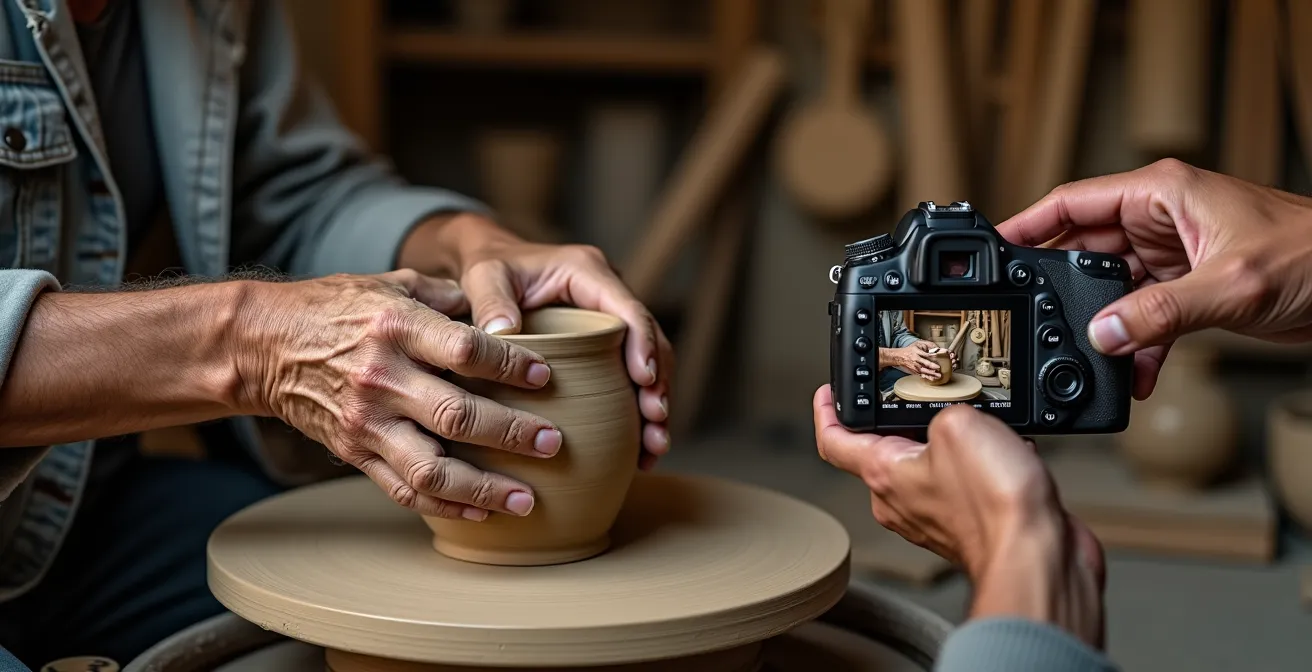
A powerful way to complete the exchange is to immediately show them the photo on your camera’s screen. This simple act turns the one-sided act of taking into a shared moment of appreciation. It closes the loop and reinforces that you see them as a collaborator, not a subject. If possible, offer to email them the photo. In many situations, focusing on environmental portraits—such as a craftsman’s hands at work, the tools of their trade, or their silhouette against their workshop—can tell a more powerful story than a direct facial portrait, while also feeling far less intrusive.
An ethical approach to photography is a non-negotiable part of respectful travel, and as many travel experts emphasize, the human element comes first. Here’s a simple process to follow:
- Make a human connection first, without your camera visible. Smile, talk, and use local greetings.
- Ask for permission with your camera down, gesturing to it only after you’ve had a genuine interaction.
- Immediately show the person the photo you took on your camera screen as a gesture of sharing.
- Offer to send them the photo via email, or if they are a vendor, purchase a small item as a thank you.
- Consider focusing on details like hands at work or tools, which can be less intrusive and tell a rich story.
The “Instagram vs. Reality” Shock That Disappoints Visitors at Major Landmarks
You’ve seen the photo a thousand times: a solitary figure contemplating a majestic, empty landmark at sunrise. Then you arrive, only to find yourself in a sea of selfie sticks, jostling for a sliver of the view you were promised. This “Instagram vs. Reality” shock is a common source of traveler disappointment. The mistake is pinning all your hopes on replicating a single, often manipulated, visual experience. When the visual reality falls short, the entire experience can feel like a failure.
The solution is to engage in a form of sensory anthropology. When your eyes are overwhelmed or underwhelmed, shift your focus to your other senses. Close your eyes for a moment. What do you hear? The murmur of a dozen different languages, the call of a street vendor, the distant sound of a local musician. What do you smell? The aroma of street food, the scent of incense from a nearby temple, the dusty smell of ancient stone. What do you feel? The texture of a worn-out step, the cool breeze in a shaded alley. By consciously cataloging these non-visual details, you create a rich, multi-sensory memory that is uniquely your own and immune to the visual clichés of social media.
A practical method for achieving this is the “Bookend Visit Strategy.” Instead of one visit during peak hours, plan two. One visit during the busiest time allows you to experience the landmark as a living social hub—to feel its energy and buzz. Then, return at sunrise or late in the evening for a completely different atmosphere of quiet contemplation. As one guide to cultural immersion suggests, use the crowds themselves as a point of interest, observing interactions and listening to stories. This dual approach allows you to appreciate both the social reality and the structural beauty of a place, ensuring a fulfilling experience regardless of the crowds.
Here is how to apply the Bookend Visit Strategy:
- Visit a famous landmark twice: once during a peak time to absorb the energy and social buzz.
- Return at sunrise or late evening for a quiet, contemplative atmosphere free from crowds.
- During the crowded visit, use the people as a conversation starter with vendors or guides to learn real local stories.
- Create a “sensory scavenger hunt” for yourself: actively identify three distinct sounds, three smells, and three textures at the site.
- Intentionally focus on experiencing both the social reality (the place with people) and the structural beauty (the place itself).
Key Takeaways
- Cultural Calibration is Key: Authentic connection begins with silent observation of non-verbal cues before attempting to interact.
- Shift from Spectator to Participant: Engage with local events and communities by contributing in small, respectful ways rather than passively consuming the experience.
- Invest in Stories, Not Just Objects: Practice ethical consumerism by seeking out generative souvenirs that support artisans and preserve cultural heritage.
How to Plan a Transformative Travel Itinerary That Skips the Tourist Traps?
The difference between a standard vacation and a transformative journey lies in the itinerary. A traditional tourist itinerary is often a rigid, packed checklist of “must-see” sights, leading to exhaustion and a feeling of merely skimming the surface. A transformative itinerary, by contrast, is a flexible framework built around opportunities for immersion, learning, and spontaneous connection. It prioritizes depth over breadth and experiences over attractions.
The fundamental shift is from planning around places to visit to planning around skills to learn or experiences to have. Instead of scheduling three museums in a day, block out an entire afternoon for “structured nothingness”—sitting in a local park or cafe with no goal other than to observe daily life. Build your trip around a 3-day cooking course, a series of pottery lessons, or joining a local hiking club for a walk. In this model, the landmarks become the backdrop to your immersive learning process, not the sole focus. The connections you make with your teacher and fellow students will often prove more memorable than any monument.
This approach requires a different way of thinking about accommodation and time management. Opting for a homestay or a locally-owned guesthouse in a residential area provides immediate insight into daily life that a hotel in a tourist district cannot. The goal is to create an itinerary with a few fixed anchors (like a pre-booked class or a specific neighborhood to explore) and wide-open spaces in between for the spontaneous opportunities that inevitably arise when you are open to them. This balance between structure and freedom is the architecture of a truly transformative trip.
This table from an analysis of immersive travel clearly contrasts the two approaches:
| Planning Aspect | Traditional Tourist Approach | Transformative Travel Approach |
|---|---|---|
| Itinerary Structure | Packed schedule of must-see sights | 2-3 fixed anchors with flexible ‘spokes’ for spontaneous opportunities |
| Time Management | Every hour scheduled with activities | Entire afternoons blocked for ‘structured nothingness’ in cafes/parks |
| Planning Focus | Places and attractions to visit | Skills to learn (cooking, pottery, local crafts) |
| Accommodation | Hotels in tourist districts | Homestays or locally-owned guesthouses |
| Daily Priorities | Checking off landmark visits | One opportunity to give back (volunteering, skill sharing) |
Start planning your next journey not as a checklist of sights, but as a project in cultural immersion. Choose one skill you want to learn or one community you want to understand, and build your itinerary around that. This shift in perspective is the first step toward a lifetime of more meaningful, authentic, and transformative travel.