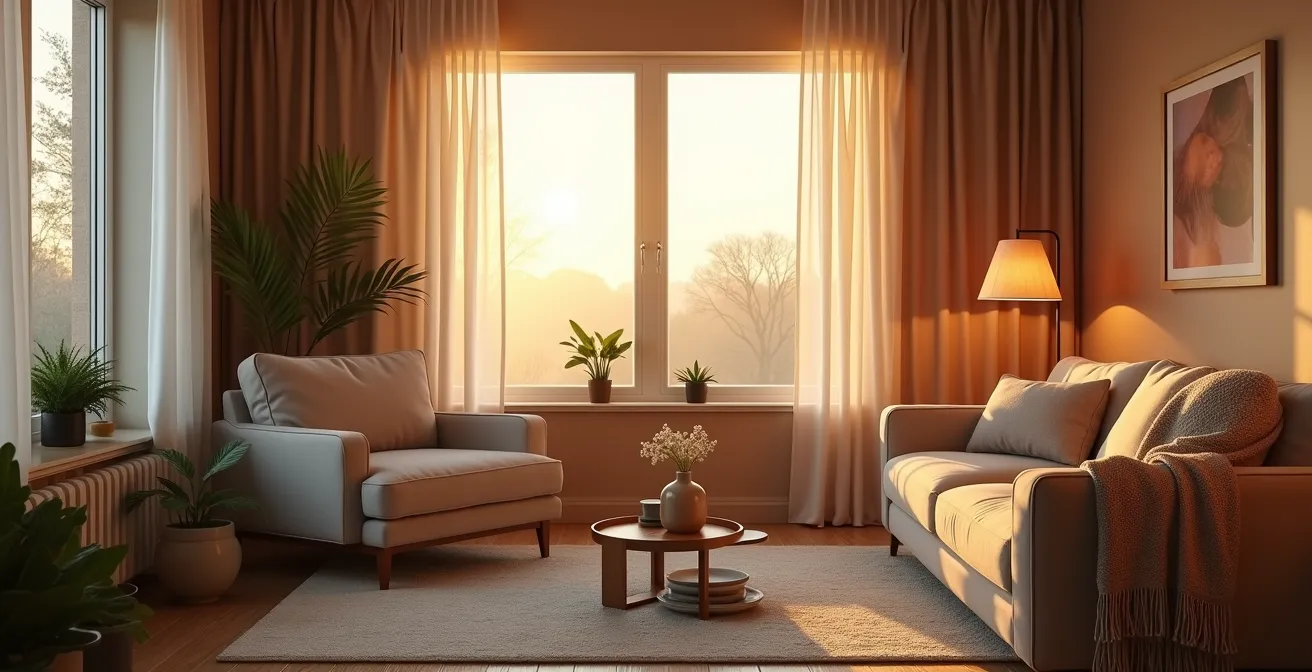
Your living room can be more than just stylish; it can be an active tool for regulating your nervous system.
- Intentional “light hygiene” in the evening is critical for lowering the stress hormone cortisol.
- Creating psychological transition rituals is more effective than simple decluttering for separating work from rest.
- The texture of fabrics and the layout of furniture directly influence your brain’s sense of safety and calm.
Recommendation: Stop decorating with trends and start designing a sensory-regulatory environment tailored to your own mental well-being.
For urban professionals with high-stress jobs, the front door should be a portal to a sanctuary, not just another room to manage. Yet, despite our best efforts with scented candles and minimalist furniture, anxiety often follows us inside. We’re told to declutter, add plants, and choose “calming” colors. While well-intentioned, this advice often misses the fundamental point: your home is a sensory environment that constantly communicates with your nervous system.
The problem isn’t a lack of style; it’s a lack of strategy. A truly restorative space isn’t built on aesthetics alone. As a designer specializing in neuro-architecture, I see homes as functional systems for mental well-being. The key isn’t just to make a space look calm, but to design it to *induce* calm at a physiological level. It’s about understanding how your brain processes light, sound, texture, and space, and then using those elements to actively down-regulate stress.
But what if the very principles of conventional design are contributing to your stress? This guide will move beyond the platitudes. We will explore how to manage your home’s sensory inputs, from the type of light that lowers cortisol to the fabric textures that promote security. We will deconstruct common layout mistakes that trigger feelings of confinement and provide a blueprint for transforming your apartment into a true restorative sanctuary, engineered for your mind.
This article provides a structured approach, grounded in environmental psychology, to re-engineer your living space for profound relaxation. Below, we’ll delve into specific strategies for mastering your home’s sensory landscape, from the science of lighting to the psychology of layout, so you can finally leave the workday’s stress at the door.
Summary: Designing a Home That Reduces Anxiety
- Why Overhead Lighting Increases Your Cortisol Levels in the Evening?
- How to Create a “Psychological Entryway” in a Studio Apartment to Separate Work From Rest?
- Velvet vs. Linen: Which Fabric Texture Promotes Better Relaxation in High-Traffic Areas?
- The Layout Mistake That Makes Your 800 sq ft Apartment Feel Claustrophobic
- When to Renovate Your Bedroom: The 3 Signs Your Sleep Environment Is Toxic
- How to Dampen Neighbor Noise With Decor Hacks That Don’t Lose Your Deposit?
- Why Blue Light from Paint Pigments Affects Your Circadian Rhythm?
- How to Turn a Standard Bathroom Into a Thermal Spa for Under $2,000?
Why Overhead Lighting Increases Your Cortisol Levels in the Evening?
The single most disruptive element in a modern living room is often the one we take for granted: the central overhead light. After a long day, flipping that switch floods the room with bright, cool-toned light that mimics midday sun. This sends a direct, and incorrect, signal to your brain. Your body’s internal clock, or circadian rhythm, associates this type of light with alertness and activity. In response, it can suppress the production of melatonin (the sleep hormone) and elevate levels of cortisol, the primary stress hormone.
This isn’t about brightness alone; it’s about the quality and direction of light. Overhead lighting casts harsh shadows, creates glare on screens, and provides a flat, uninteresting visual field that can feel sterile and unwelcoming. For a nervous system already taxed by a day of overstimulation, this is the opposite of calming. To create a restorative environment, you need to practice what neuro-architects call “light hygiene,” shifting from a single, dominant light source to a layered, strategic approach.
The goal is to create pools of warm, indirect light that guide the eye and signal to your brain that the day is winding down. This involves using multiple, lower-level light sources to build an atmosphere of safety and comfort. The illustration below shows how different zones of light can transform a room from a stark box into a soothing retreat.
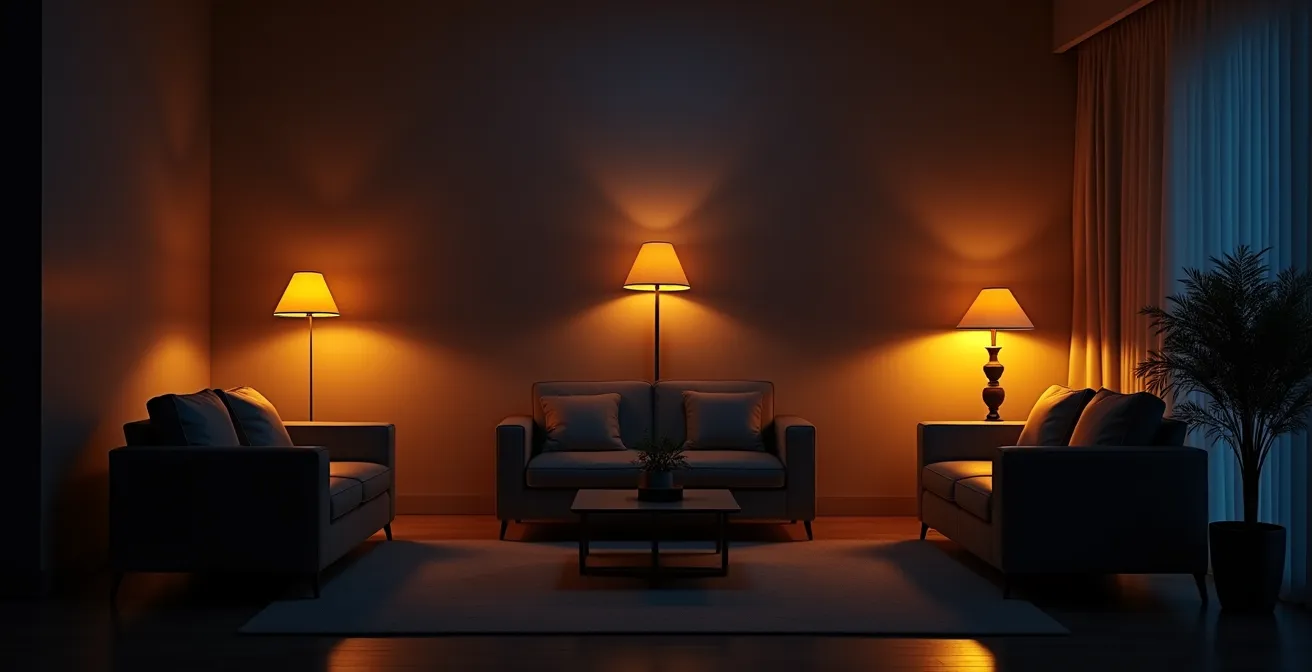
As you can see, this strategy uses a hierarchy of light—ambient, task, and accent—to create depth and visual interest without overwhelming the senses. By placing lights at human-level, you foster a more intimate and grounded atmosphere. This is the first and most critical step in transforming your living room into a space that actively works to lower, not raise, your anxiety.
How to Create a “Psychological Entryway” in a Studio Apartment to Separate Work From Rest?
In a studio or open-plan apartment, the line between work and rest is often nonexistent. Your laptop sits on the coffee table, work papers pile up on the kitchen counter, and the visual cues of your job are ever-present. This constant reminder of your professional responsibilities prevents the mental “closing of tabs” necessary for true relaxation. The solution isn’t just to tidy up; it’s to create a “psychological entryway”—a designated transition zone and ritual that signals the end of the workday.
This concept is about creating a deliberate moment of psychological decompression. It starts with a physical “drop zone” right by the door. This could be a small credenza, a narrow console table with drawers, or a closed-storage ottoman. The rule is simple: at the end of the day, all work-related items—laptop, notebook, work phone—are placed inside this storage and hidden from view. Out of sight truly is out of mind. Forest Homes’ research highlights how these transition spaces reduce anxiety, as participants reported feeling more relaxed when work items were physically contained.
The second part of the ritual is sensory. As you put your work items away, engage another sense to anchor the transition. This could be turning on a specific, low-lit lamp, starting a 15-minute essential oil diffuser with a calming scent like lavender or cedarwood, or playing a specific ‘after-work’ playlist. This sensory cue reinforces the shift in your brain, creating a powerful association between the action and the feeling of relief. By ritualizing this boundary, you’re not just organizing your space; you’re actively managing your cognitive load and telling your nervous system that it is now safe to switch off.
Velvet vs. Linen: Which Fabric Texture Promotes Better Relaxation in High-Traffic Areas?
When designing a restorative space, we often focus on what we see, but what we feel can have an even more profound impact on our sense of well-being. The choice of fabric for high-contact surfaces like a sofa or an armchair is a critical decision in sensory design. The haptic feedback—the information your brain receives through touch—from these materials can either soothe or subtly agitate your nervous system. The two popular contenders, velvet and linen, offer distinctly different sensory experiences.
Velvet, with its dense, uniform pile, provides a smooth and consistent tactile sensation. This lack of friction is processed by the brain as safe and comforting, often evoking a sense of security and grounding. It absorbs light, giving it a deep visual weight that can make a space feel more enclosed and protected. Linen, by contrast, is a natural, textured fabric that is cool to the touch and breathable. Its slight irregularities and crisp feel are perceived as refreshing and light. It reflects light, contributing to a more airy and open feeling.
The choice is not about which is “better,” but which is better for your specific goal in a particular area. In a high-traffic living room, durability and maintenance stress are also factors. Performance velvets and linen-poly blends now offer the sensory benefits without the high-stress care, making them ideal for daily use. The key is often to use both in a balanced texture palette, as shown below.

To make the right decision for your sanctuary, consider not just the look but the feeling you want to cultivate. A velvet accent chair can be a cozy, secure nook for reading, while a linen sofa can provide a light, breathable anchor for the main seating area. A detailed comparison can help guide your choice.
| Property | Velvet | Linen | Best Use Case |
|---|---|---|---|
| Haptic Feedback | Smooth, consistent, security-inducing | Cool, breathable, naturally textured | Velvet for accent chairs; Linen for sofas |
| Temperature Regulation | Warm, insulating | Cool, moisture-wicking | Velvet for cool climates; Linen for warm spaces |
| Maintenance Stress | Performance velvet: Low | Linen-poly blend: Low | Choose blends for high-traffic areas |
| Sensory Effect | Grounding, comforting | Refreshing, light | Mix both for texture palette |
| Visual Weight | Heavy, luxurious | Light, casual | Balance based on room size |
The Layout Mistake That Makes Your 800 sq ft Apartment Feel Claustrophobic
In a small apartment, the most common layout mistake is pushing all the furniture flat against the walls. While it seems logical to maximize the open floor space in the center, this “waiting room” arrangement often backfires, creating a boxy, static feeling that heightens a sense of confinement. Your brain perceives this rigid grid as a barrier, with poor flow and short, abrupt sightlines. This visual tension contributes to a low-grade, persistent feeling of being trapped—the last thing you need after a stressful day.
Furthermore, this layout often ignores the psychological impact of clutter. When every surface is occupied and pathways are unclear, you create excessive visual stimuli. According to Psychology Today research, clutter in the brain causes stress, guilt, and a feeling of being overwhelmed. The solution lies in creating clear pathways and longer perceptual sightlines, which can be achieved with a counter-intuitive move: pulling furniture away from the walls and angling it.
Consider the “Diagonal Axis Principle.” As demonstrated by interior designer Sarah Barnard, angling a key piece of furniture, like the sofa, can dramatically alter the perception of a room. In one case study, placing the sofa diagonally in a 750 sq ft apartment created 30% longer perceived sightlines and improved traffic flow. This breaks the “box” and guides the eye along a longer path, making the space feel larger and more dynamic. It also naturally creates “zones”—a reading corner, a conversation area—that give the room purpose and order.
To implement this, start by identifying the longest possible diagonal line in your room (e.g., from the entryway to the far-corner window). Align your main seating arrangement along this axis. Pull furniture a few inches off the walls to let the space “breathe.” Ensure there are clear, unimpeded pathways at least 3 feet wide. This intentional design choice replaces visual chaos with a sense of graceful movement and openness, allowing your mind to relax and expand.
When to Renovate Your Bedroom: The 3 Signs Your Sleep Environment Is Toxic
The bedroom should be the ultimate sanctuary, a space dedicated purely to rest and rejuvenation. However, for many, it has become a multi-purpose room filled with stressors that poison the sleep environment. A renovation doesn’t have to mean tearing down walls; often, it’s a “renovation” of purpose and sensory inputs. If you consistently wake up feeling tired or feel a sense of dread when entering your bedroom, it’s time for an audit. Here are three critical signs your sleep environment has become toxic.
First, your bedroom has become a ‘second living room.’ The boundaries have blurred. Look around for signs of this toxic creep: a TV flickering in the corner, a makeshift work desk piled with papers, or exercise equipment gathering dust. Each of these items carries an association with alertness, stress, or activity, sending conflicting signals to your brain when it should be winding down for sleep. The bedroom must be reclaimed as a monofunctional space dedicated to sleep and intimacy only.
Second, sensory pollution is high. This is a broader issue covering all senses. Is your mattress uncomfortable or causing pain? Is your bedding made from synthetic materials that don’t breathe, causing you to overheat? Is there persistent, low-level noise from appliances or outside? Is the only lighting option a harsh overhead fixture? Is the room filled with visual clutter? Answering yes to any of these points to a sensory environment that is actively working against, not for, your rest.
Finally, you experience negative psychological associations. This is the most telling sign. Pay attention to how you feel the moment you walk into your bedroom. Do you feel a wave of anxiety, a sense of obligation to clean up, or a general feeling of unease? If the space doesn’t trigger an immediate feeling of relief and safety, your brain has formed a negative association with it. This is a clear signal that the room’s function has been compromised and a strategic overhaul is needed to reclaim it as a true haven for rest.
How to Dampen Neighbor Noise With Decor Hacks That Don’t Lose Your Deposit?
In apartment living, few things are more anxiety-inducing than inescapable noise from neighbors. The unpredictable thud of footsteps, the muffled bass of a TV, or the drone of conversation can keep your nervous system on high alert. This isn’t just an annoyance; it’s a physiological stressor. In fact, research published in 2024 shows that continuous sound levels ≥30 dB(A) during sleep can elevate cortisol and noradrenaline levels, disrupting rest and recovery.
For renters, soundproofing can seem impossible without structural changes that would forfeit a security deposit. However, you can significantly dampen noise by applying a simple acoustic principle: adding mass and absorption. Sound waves can be blocked by heavy, dense objects (mass) and soaked up by soft, porous surfaces (absorption). By strategically using decor, you can create a quieter, more serene environment without a single nail.
The key is a multi-layered approach that tackles different sound frequencies. High-frequency sounds (like voices) are best handled by soft textiles, while low-frequency sounds (like bass) require mass. Combining these strategies provides the most effective, renter-friendly solution. Below is a checklist of actionable steps you can take to reclaim your peace and quiet.
Your Action Plan: Renter-Friendly Sound Dampening
- Layer soft textiles: Hang thick, heavy curtains (velvet is excellent) over windows and even on shared walls. Add large area rugs (with a thick felt pad underneath) and wall tapestries to absorb high-frequency chatter.
- Create mass barriers: Position large, filled bookcases against shared walls. Books are dense and irregular, making them a fantastic, functional sound blocker for trapping bass frequencies.
- Establish buffer zones: Avoid placing your sofa or bed directly against a shared wall. Pull furniture 2-3 inches away to create a small air gap, which disrupts sound transmission. Placing a console table behind a sofa can enhance this effect.
- Add pink noise masking: Instead of trying to achieve total silence, mask intrusive sounds. A sound machine with “pink noise” is more effective than white noise for masking human voices and creating a consistent, soothing auditory backdrop.
- Use temporary acoustic panels: Modern acoustic panels made from felt or mineral wool can be mounted with removable adhesive strips. Place them strategically on a shared wall to absorb sound without leaving a mark.
Why Blue Light from Paint Pigments Affects Your Circadian Rhythm?
The conversation around blue light typically centers on our digital screens, but there’s a more pervasive source in our homes: our walls. The color you paint a room does more than just set a mood; its underlying pigments interact with light to affect your biology. Specifically, the amount of blue light reflected by your walls in the evening can disrupt your circadian rhythm, the 24-hour cycle that governs sleep and wakefulness.
All light is composed of a spectrum of colors. During the day, natural sunlight is rich in blue light, signaling to our brains to be awake and alert. In the evening, as the sun sets, this blue light diminishes. The problem arises when our artificial lighting at night illuminates paint colors with cool, blue-based pigments. This is common in many popular “neutral” grays, crisp whites, and even some blues and greens. These surfaces reflect a higher amount of blue light into the room, sending a subtle but persistent “daytime” signal to your brain long after sunset.
A study by Happy DIY Home with interior designer Jen Stark found that participants in bedrooms painted with soft blues or pale greens reported better sleep than those in rooms with cool grays or bright whites. The crucial finding was that warm-undertone neutrals reflect significantly less blue light under artificial evening lighting. This is why choosing the right paint is a matter of neuro-architecture, not just aesthetics. Instead of a stark, cool white, consider an off-white with creamy or yellow undertones. Instead of a steely gray, opt for a “greige” with warm, beige undertones. These warmer colors help create an environment that aligns with your body’s natural rhythm, promoting the production of melatonin and preparing you for restful sleep.
Key Takeaways
- Your home’s design should be a functional tool for regulating your nervous system, not just an aesthetic exercise.
- Managing sensory inputs—light, sound, and touch—is more effective for reducing anxiety than following generic decor trends.
- Creating rituals and clear boundaries between work and rest zones is crucial for psychological decompression in any living space.
How to Turn a Standard Bathroom Into a Thermal Spa for Under $2,000?
The bathroom is a uniquely potent space for anxiety reduction. It’s one of the few rooms where you are truly alone, and the presence of water offers a powerful tool for sensory regulation. Transforming a standard, functional bathroom into a private thermal spa is an achievable project that synthesizes many of the principles we’ve discussed: managing light, temperature, sound, and touch to create an immersive sanctuary. And it doesn’t require a full gut renovation; a budget of under $2,000 can yield a profound transformation.
The goal is to engage the senses in a way that signals safety and relaxation. This starts with water temperature. A thermostatic shower valve is a game-changer; it maintains a consistent water temperature, eliminating the stressful shocks of sudden hot or cold water that can spike anxiety. Paired with a rainfall showerhead that provides gentle, consistent pressure, it mimics the calming effect of natural rain. Next, engage the sense of touch and warmth beyond the shower with a heated towel rack. The comfort of wrapping yourself in a warm towel signals safety to the primitive parts of your brain.
Lighting is, once again, critical. Replace the harsh overhead vanity light with dimmable sconces. A dimmer switch is perhaps the single most cost-effective upgrade for any room, but it’s essential in the bathroom for creating a low-light, end-of-day wind-down environment. Finally, incorporate sound with a waterproof speaker for playing calming music or pink noise, and bring in natural materials like teak or bamboo accessories to add a biophilic, grounding element. These small, strategic upgrades work together to create a holistic, multi-sensory healing experience.

Below is a breakdown of components that can help you plan your budget-friendly spa transformation. Each element is chosen for its specific anxiety-reducing benefit, turning your bathroom into a reliable tool for daily stress relief.
| Component | Budget Range | Anxiety-Reducing Benefit | Installation |
|---|---|---|---|
| Thermostatic Shower Valve | $300-600 | Consistent temperature prevents stress spikes | Professional required |
| Heated Towel Rack | $200-500 | Warm towel comfort signals safety to nervous system | DIY possible |
| Rainfall Showerhead | $100-300 | Gentle water pressure reduces sensory overwhelm | DIY friendly |
| Dimmer Switch | $50 | Adjustable lighting for evening wind-down | Electrician recommended |
| Waterproof Speaker | $50-100 | Pink noise or calming music for stress relief | No installation |
| Teak/Bamboo Accessories | $100-200 | Natural materials promote biophilic calm | No installation |
To truly create a restorative home, the next logical step is to apply these sensory-aware principles to your own space. Begin by auditing one room—start with your living room or bedroom—and identify the single biggest sensory stressor. Your journey to a less anxious life can start today, with one small, intentional design choice.