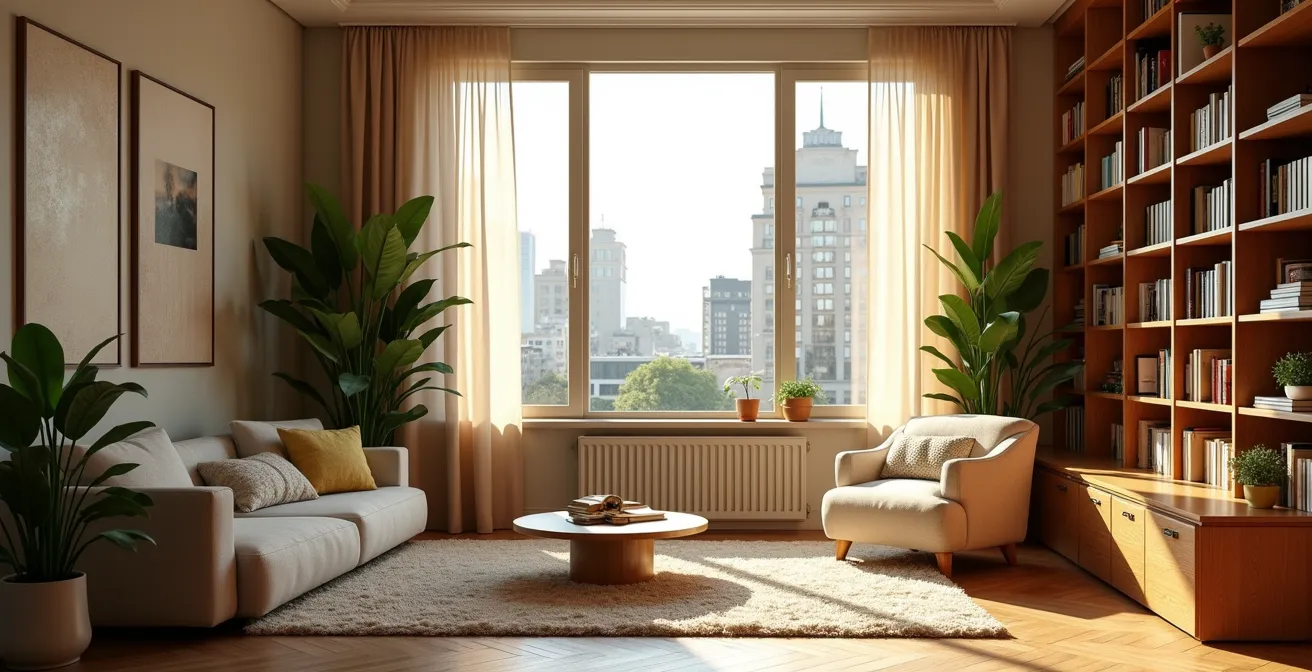
Achieving true silence in a city apartment requires an engineering mindset focused on dismantling noise at its source, not just masking it.
- Low-frequency traffic noise isn’t just annoying; it’s a physiological threat directly linked to cardiovascular disease.
- Effective sound control combines strategic mass (like bookshelves), damping (soft materials), and sealing air gaps, while managing psychological stressors like light.
Recommendation: Adopt a holistic “acoustic ecology” approach by identifying your specific noise frequencies and applying targeted physical and psychological solutions to reclaim your sanctuary.
For the urban dweller, the relentless soundtrack of the city—the distant siren, the rumble of traffic, the upstairs neighbor’s footsteps—is a constant companion. The common advice often feels temporary: use earplugs, buy a white noise machine, or add a few decorative pillows. While these methods offer fleeting relief, they fail to address the fundamental physics of sound and its profound psychological impact. They are acoustic bandages on a structural wound, masking symptoms rather than curing the problem.
The frustration is real for those who cannot simply pack up and move to a quiet suburb. You are bound by lease, location, and budget. But what if the solution wasn’t about escape, but about transformation? What if you could re-engineer your existing space into an acoustic sanctuary? The key lies not in generic decorating tips, but in adopting the systematic, problem-solving approach of an acoustic engineer. It’s about understanding the difference between high-frequency chatter and low-frequency rumble, and knowing that each requires a unique strategy.
This guide moves beyond the superficial to provide a technical framework for peace and quiet. We will dissect the science behind urban noise and its effect on your health, from cardiovascular risks to stress hormone spikes. We will then explore strategic, renter-friendly interventions that use principles of mass, damping, and psychological acoustics to create a genuinely quiet home. You will learn how to analyze your apartment’s specific vulnerabilities and implement solutions that offer lasting tranquility, proving that you don’t need to move out to shut the noise out.
To help you navigate these solutions, this article breaks down the core components of creating an acoustically sound and mentally restful living space. The following sections will guide you through the science, strategies, and practical steps to transform your apartment.
Summary: A Technical Guide to Urban Soundproofing
- Why Low-Frequency Traffic Noise Increases Your Risk of Heart Disease?
- How to Dampen Neighbor Noise With Decor Hacks That Don’t Lose Your Deposit?
- Top Floor vs. Courtyard Facing: Which Unit Is Actually Quieter in a High-Rise?
- The “Crowding Stress” That Makes Urbanites Irritable and How to Counter It
- How to Reclaim Your 45-Minute Subway Commute for Mental Health?
- Where to Place Plants to Dampen City Noise Entering Through Windows?
- Why Overhead Lighting Increases Your Cortisol Levels in the Evening?
- How to Select Indoor Plants That Actually Purify Air in a 200 sq ft Room?
Why Low-Frequency Traffic Noise Increases Your Risk of Heart Disease?
The constant, deep hum from traffic is more than a simple annoyance; it is a significant environmental stressor with measurable physiological consequences. Unlike high-frequency sounds that are easily blocked by walls, low-frequency noise (like the rumble of trucks or buses) penetrates structures with ease, vibrating through windows, floors, and even concrete. This pervasive energy keeps the body’s stress-response system in a state of low-grade, chronic alert. Your brain interprets this constant rumble as a potential threat, triggering the release of stress hormones like cortisol and adrenaline, even while you sleep.
This sustained state of alert puts a direct strain on the cardiovascular system. It elevates blood pressure, increases heart rate, and can contribute to arterial inflammation over time. A landmark 2024 study on urban noise highlights this danger, confirming a direct association between chronic transportation noise and a heightened risk of cardiovascular diseases, including myocardial infarction and stroke. The research validates warnings from the World Health Organization (WHO), which has long identified transportation noise as a cause for a significant loss of healthy life years across Western Europe. This isn’t just about losing sleep; it’s about a persistent, invisible force actively compromising your long-term heart health.
Understanding this mechanism is the first step in effective mitigation. Simply masking the sound with white noise is insufficient because your body still registers the underlying vibrations. True solutions must focus on blocking and damping this specific, harmful frequency range to give your nervous system a genuine opportunity to rest and recover.
How to Dampen Neighbor Noise With Decor Hacks That Don’t Lose Your Deposit?
Tackling neighbor noise in a rental property requires strategies that are both effective and non-destructive. The core engineering principles are adding mass and density to walls and decoupling your space from the source of vibration. Forget expensive, permanent renovations; your existing decor can be weaponized for acoustic control. The most common mistake is thinking a few soft tapestries will suffice. To block sound, you need mass.
Your most powerful tool is a large, fully stocked bookshelf placed against a problematic shared wall. The combined mass of the books, the wood of the shelf, and the varied shapes and densities create a formidable barrier that disrupts and absorbs sound waves. The more irregular the surface (achieved by varying book sizes and interspersing objects), the better it is at scattering sound. This approach is far more effective than thin acoustic foam panels, which primarily handle echo within a room, not sound transmission between rooms.
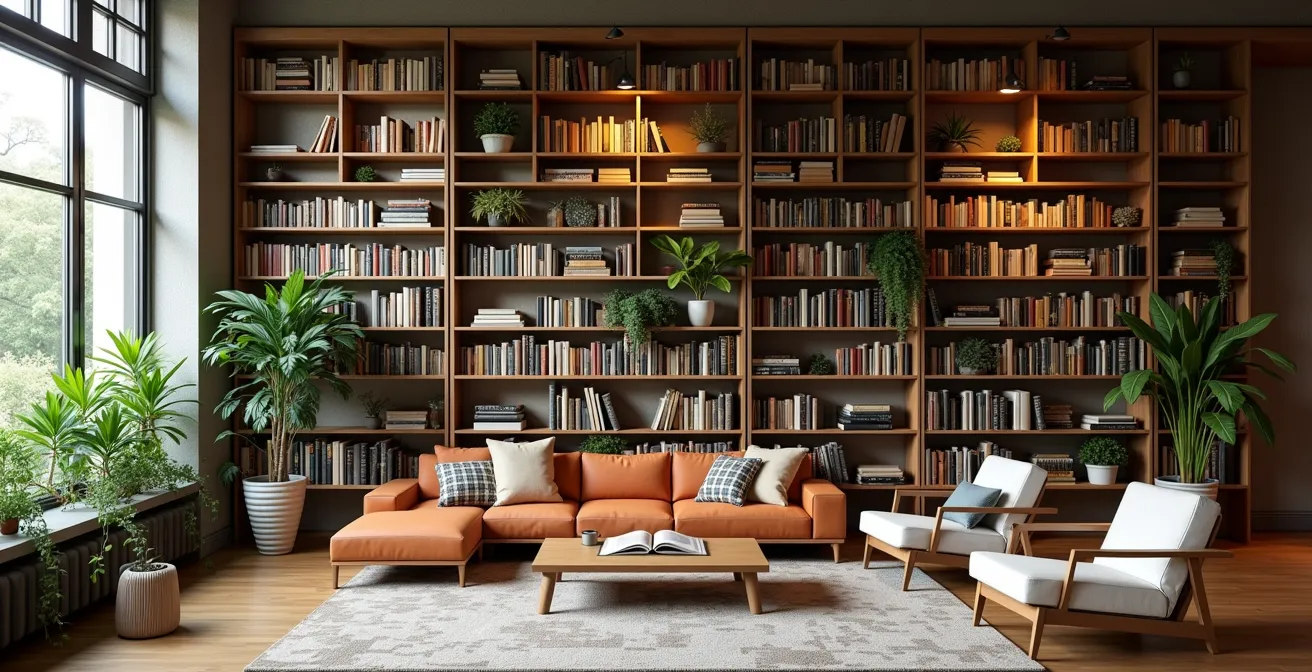
Beyond mass, sealing air gaps is critical, as sound travels efficiently through any opening. Apply removable weatherstripping around your front door to block hallway chatter. A door sweep, which can be easily uninstalled, will seal the gap at the floor. For windows, combining heavy, thick curtains with an additional layer of a thick rug on the floor below can create a powerful damping system. Layering materials—a rug with a dense underlay pad, for example—is always more effective than a single layer, as each material will dampen a different range of frequencies.
Top Floor vs. Courtyard Facing: Which Unit Is Actually Quieter in a High-Rise?
When apartment hunting, prospective tenants often assume a top-floor unit is the quietest option, free from the dreaded sound of footsteps from above. While this eliminates impact noise from neighbors, it’s an oversimplification. From an acoustic engineering standpoint, the “quietest” unit depends entirely on the type of noise you want to avoid. A top-floor apartment often has greater exposure to street and traffic noise, as sound waves travel upwards with little obstruction. It can also be subject to mechanical noise from rooftop HVAC units or elevator machinery.
Conversely, a courtyard-facing unit is shielded from direct street noise but can suffer from the “urban canyon” effect. This phenomenon occurs when sound from within the courtyard—voices, music, air conditioners—bounces between the hard, parallel surfaces of the buildings, amplifying and reverberating. What might be a quiet conversation at ground level can become an intrusive echo several floors up. According to EPA guidelines, consistent exposure above 70 dB(A) can increase health risks, while levels should be kept below 45 dB inside to avoid sleep disruption and elevated blood pressure.
Apartment noise is more than a nuisance, it’s also a health risk. Experts say that consistent exposure above roughly 70 dB(A), like busy city streets, can increase the risk of hearing damage and stress. The EPA recommends keeping noise below about 55 dB outdoors and 45 dB inside to avoid issues, including disrupted sleep and elevated blood pressure.
– Environmental Protection Agency, EPA Noise Guidelines
The choice involves a trade-off between different acoustic profiles. The following table breaks down the noise exposure for each location, helping you make a more informed decision based on your sensitivity to specific sounds.
| Factor | Top Floor | Courtyard Facing |
|---|---|---|
| Impact Noise from Above | None | Present |
| Street/Traffic Noise | Higher exposure | Shielded |
| HVAC/Mechanical Noise | Roof equipment noise | Minimal |
| Neighbor Noise Echo | Less reverberation | Urban Canyon Effect amplification |
| Low-Frequency Rumble | More exposure | Partially blocked |
The “Crowding Stress” That Makes Urbanites Irritable and How to Counter It
The feeling of being overwhelmed in a city isn’t just about noise; it’s also about a lack of personal space, a phenomenon known as “crowding stress.” This psychological state arises when the constant proximity to others and the confinement of small living quarters trigger a persistent, low-level fight-or-flight response. Your brain perceives the environment as unpredictable and overstimulating, leading to heightened irritability, reduced patience, and mental fatigue. This constant environmental pressure is a major public health issue; WHO data reveals an estimated loss of 1.6 million healthy life years annually in Western Europe due to traffic noise alone, a key component of urban environmental stress.
Countering crowding stress within the four walls of your apartment requires creating a sense of psychological boundary and control. This is achieved by “zoning” your space. Instead of having one large, multi-purpose area, use furniture, rugs, and lighting to create distinct functional zones: a dedicated space for work, a corner for relaxation, and an area for dining. This physical separation sends clear signals to your brain, allowing it to transition between different mental states. A small reading nook with a comfortable chair and a single floor lamp becomes a “safe zone,” a predictable sanctuary where the brain learns it can disengage from the outside world’s chaos.
Lighting plays a particularly crucial role in this strategy. Using warm, low-level lamps to create “pools of calm” is highly effective. These islands of soft light serve as visual cues for rest, signaling to your brain that it is safe to downshift from a state of high alert. By curating your environment to provide these predictable zones of tranquility, you regain a sense of control and actively reduce the cognitive load that fuels urban irritability.
How to Reclaim Your 45-Minute Subway Commute for Mental Health?
The daily commute is often a major source of stress, bombarding you with noise, crowds, and sensory overload right before you get home. Instead of passively enduring it, you can transform this time into a deliberate mental health ritual—a structured transition that allows you to shed the day’s stress and arrive home in a calmer state. An effective commute routine acts as an “airlock” between your professional and personal life, preventing work stress from contaminating your home sanctuary. It’s not about ignoring the chaos, but about actively managing your internal state within it.
A powerful method is the “Three-Part Mental Health Routine,” which divides your commute into distinct phases of processing, shifting, and preparing. This structured approach ensures you systematically decompress. Additionally, for moments of acute overwhelm, the 5-4-3-2-1 grounding technique is an excellent tool. It forces your brain to focus on the immediate sensory environment, pulling you out of anxious thought loops and back into the present moment. By consciously engaging in these practices, you reclaim the commute as your own time.
- Part 1 – The Download (15 mins): Use the first part of your journey to offload the mental baggage from your workday. Write in a journal, type notes on your phone, or use a voice recorder to capture any lingering thoughts, frustrations, or to-do items. The act of externalizing them clears your mind.
- Part 2 – The Shift (15 mins): This is where you actively change your mental channel. Listen to a curated playlist of calming music, a podcast completely unrelated to your work, or even binaural beats designed for relaxation. The goal is to introduce new sensory input that overwrites the stress signals.
- Part 3 – The Ramp-Up (15 mins): In the final stretch, shift your focus toward home. Plan a small, positive activity to look forward to, like preparing a favorite meal or watching a specific show. Practice gratitude by mentally listing three good things that happened during the day, no matter how small.
Where to Place Plants to Dampen City Noise Entering Through Windows?
Windows are the most significant acoustic weak points in an apartment, allowing a flood of city noise to enter. While double-paned windows are effective, they are a costly upgrade often out of reach for renters. A surprisingly effective and renter-friendly solution is to create a “green barrier” using houseplants. The effectiveness of plants as sound absorbers comes from their complex surfaces—leaves, stems, and branches—which scatter and absorb sound waves, particularly in the mid-to-high frequency range of human speech and tire hiss.
The key to success is density and layering. A single, sparse plant will have a negligible effect. Instead, arrange multiple plants with dense foliage in front of your windows. Think of it as creating a miniature forest on your windowsill or on shelves placed across the window. Broad-leaved plants like Fiddle Leaf Figs and Rubber Plants provide large surfaces for sound to hit, while plants with many small, intricate leaves, like ferns, create a complex web that traps and diffuses sound energy. According to a 2014 study by the University of Perugia, certain species are exceptionally effective; it was found that ferns can absorb a significant amount of incident acoustic energy.
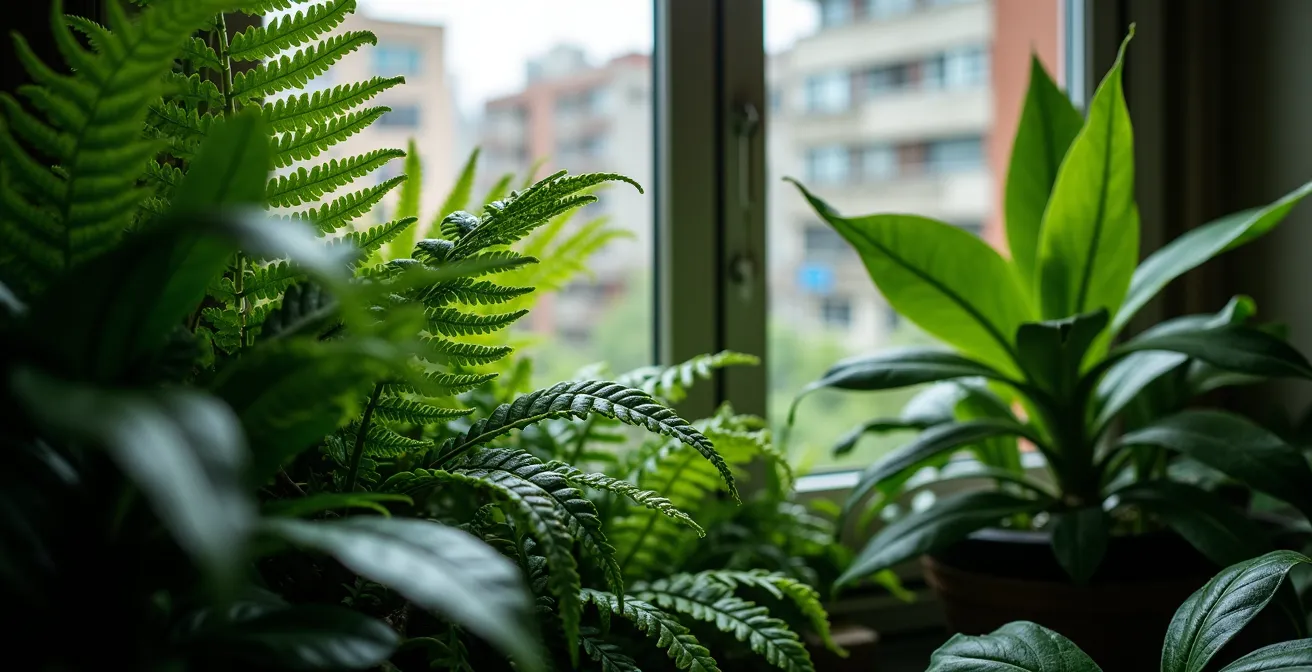
For maximum impact, place the plants as close to the window pane as possible to intercept the sound at its entry point. Use a variety of plant heights and leaf types to create a multi-layered buffer. A combination of tall floor plants, medium-sized plants on a bench, and smaller pots on the windowsill creates an effective, multi-layered acoustic screen. This not only dampens noise but also adds a powerful visual element of tranquility, transforming a source of stress into a view of nature.
Why Overhead Lighting Increases Your Cortisol Levels in the Evening?
The connection between light and sound is a critical, yet often overlooked, aspect of psychological acoustics. Your sensitivity to noise is not static; it is directly influenced by your physiological state, particularly your stress levels. Harsh, bright overhead lighting in the evening, especially from bulbs that emit a high amount of blue-spectrum light, can artificially increase your body’s production of the stress hormone cortisol. This is because your brain’s circadian rhythm system interprets bright, cool light as a signal for daytime alertness.
When cortisol levels are elevated in the evening—a time when they should be naturally decreasing to prepare for sleep—your entire nervous system is put on higher alert. This heightened state of arousal makes you more sensitive and less tolerant to all sensory inputs, including noise. A sound that you might have ignored during the day can feel jarring and intrusive at night. Research on circadian rhythms clearly shows that evening exposure to blue-spectrum light disrupts hormonal balance and can reduce your psychological resilience to noise.
By managing your home’s lighting, you can directly influence your hormonal balance and, in turn, your perception of noise. Switching from a single, bright overhead source to multiple, lower-level lamps with warm-toned bulbs is a powerful strategy. This “light zoning” creates a calming environment that supports the natural decline of cortisol, making you feel more relaxed and less disturbed by the inevitable sounds of city life. The following checklist provides a clear action plan for implementing this strategy.
Action Plan: Light Zoning for Noise Resilience
- Assess your sources: Turn off all overhead lights after sunset to eliminate the primary source of blue-light exposure.
- Distribute light: Use multiple low-level light sources, such as table lamps and floor lamps, to create a layered and gentle illumination.
- Select the right bulbs: Choose warm-toned bulbs with a color temperature below 2700K to mimic the natural light of sunset.
- Create light pools: Position your lamps to create distinct “pools of light” for specific activities like reading or relaxing, avoiding general, uniform brightness.
- Eliminate glare: Position lights to provide an ambient glow rather than direct glare, which can be stimulating and stressful for the eyes.
Key Takeaways
- Differentiate and Conquer: Don’t treat all noise the same. Identify whether you’re dealing with low-frequency rumble or high-frequency chatter and apply targeted solutions like mass for the former and absorption/sealing for the latter.
- Control Psychological Factors: Your perception of noise is tied to your stress levels. Managing evening light to lower cortisol and creating psychological boundaries through “zoning” can make you more resilient to sound.
- Think in Layers: A single soundproofing solution is rarely enough. The most effective strategies involve layering materials—a rug with an underpad, curtains over window inserts, or dense bookshelves—to dampen a wider range of frequencies.
How to Select Indoor Plants That Actually Purify Air in a 200 sq ft Room?
Creating a true sanctuary involves more than just managing sound; it also means ensuring the quality of the air you breathe. Indoor air can be surprisingly polluted with volatile organic compounds (VOCs) released from furniture, cleaning products, and paints. While an expensive air purifier is one option, a more natural and aesthetically pleasing solution is to populate your space with plants known for their air-purifying capabilities. This approach is rooted in extensive research, most famously the NASA Clean Air Study, which identified specific plants that are highly effective at removing common indoor toxins.
For a small space like a 200 sq ft room, the key is to choose hardworking plants that are also tolerant of typical indoor conditions. You don’t need a dense jungle to see benefits. Selecting a few strategic plants can make a noticeable difference. Top candidates include the Snake Plant (Sansevieria), which is exceptional because it converts CO2 into oxygen at night, making it perfect for bedrooms. The Spider Plant (Chlorophytum comosum) is another excellent choice, known for being easy to care for and highly effective at removing formaldehyde and xylene.
When selecting plants, consider a mix of species to target different pollutants. Peace Lilies (Spathiphyllum) are great for removing ammonia, while English Ivy (Hedera helix) is effective against benzene. The number of plants needed depends on their size and the level of pollutants, but a general guideline for a 200 sq ft room would be two to four medium-sized plants. By integrating these natural air filters into your decor, you complete your apartment’s transformation into a holistic environment that supports both mental tranquility and physical health.
By applying these engineering principles systematically, you can move beyond simple fixes and fundamentally transform your apartment’s acoustic and psychological environment. Start today by identifying your primary noise source and implementing one targeted strategy to begin reclaiming your peace.