
The effectiveness of a vitamin is determined by its molecular structure and biological context, not just the dose listed on the bottle.
- Many synthetic vitamins lack the necessary cofactors and have different isomeric forms, leading to poor absorption and utility by the body.
- Nutrient absorption is a complex process involving transport proteins and competition between minerals for the same cellular pathways.
Recommendation: Prioritize nutrient density from whole foods and choose supplements based on their specific chemical form and bioavailability, not just their price or dosage.
The supplement aisle is a dizzying landscape of promises. Brightly colored bottles boast high-potency formulas, claiming to boost everything from your immune system to your energy levels. As a health optimizer, you invest in these products expecting tangible value, but a nagging question often remains: are you truly nourishing your body, or just creating expensive urine? The common advice is to “eat a balanced diet” or to simply pick the bottle with the highest numbers. This approach, however, ignores the fundamental biochemistry at play.
The conversation often gets simplified to “natural vs. synthetic,” but the reality is far more nuanced. It involves molecular shapes, carrier proteins, and fierce competition for absorption at a cellular level. Your body doesn’t read the marketing label; it responds to precise chemical keys fitting into specific biological locks. Understanding this difference is the key to unlocking true value from both your food and your supplements.
This article will move beyond the surface-level debate. We will dissect the biochemical mechanisms that govern whether a nutrient is used, stored, or simply excreted. From the molecular difference in vitamin E isomers to the competitive dance of minerals like zinc and copper, you’ll gain a biochemist’s perspective on what’s really happening after you swallow that pill. We will explore why nutrient transport is as critical as absorption, why even “healthy” vegetables can be nutritionally weak, and how you can apply this knowledge to make truly informed decisions.
To navigate this complex topic, we will break down the core principles of nutrient bioavailability. This guide will provide a clear, science-backed framework to help you understand what truly matters for your health.
text
Summary: Decoding Nutrient Bioavailability and Smart Supplementation
- Why Your Expensive Multivitamin Might Be Creating “Expensive Urine”?
- How to Calculate Your Protein Needs Based on Lean Body Mass?
- The Magnesium Deficiency Signs That 60% of Adults Ignore
- The Fat-Soluble Vitamin Mistake That Can Damage Your Liver
- When to Take Zinc and Copper to Avoid Competition for Absorption?
- Why Spinach Losing 50% of Its Nutrients After 3 Days in Transit?
- Thermogenics vs. Cold Exposure: Which Safely Activates Brown Fat?
- How to Grocery Shop at a Farmers Market to Maximize Nutrient Density?
Why Your Expensive Multivitamin Might Be Creating “Expensive Urine”?
The concept of “expensive urine” is a blunt but accurate description of what happens when the body is fed nutrients in a form it cannot effectively use. You ingest a high-potency vitamin, but your cells lack the mechanisms to absorb or utilize it, so it’s filtered by the kidneys and excreted. This is a common fate for many low-cost, synthetic vitamins. From a molecular standpoint, not all vitamin forms are created equal, even if they share the same name. They can have different three-dimensional shapes, known as isomers, and the body’s enzymes and transport systems are highly specific to these shapes.
Vitamin E is a classic example. The natural form, d-alpha-tocopherol, consists of a single isomer. Synthetic vitamin E, or dl-alpha-tocopherol, is a mixture of eight different isomers, only one of which (12.5%) is identical to the natural form. The result is a dramatic difference in utility. In fact, studies show that natural vitamin E is absorbed twice as efficiently as its synthetic counterpart. Your body simply recognizes and utilizes the bio-identical shape more effectively, while the other seven isomers are largely ignored.
This principle extends to many other nutrients. Synthetic vitamins are often “isolated” molecules, stripped of the necessary cofactors—other vitamins, minerals, and enzymes—that are naturally present in whole foods. These cofactors are essential for proper absorption and function. As Dr. Berg, a proponent of natural health, states:
Many people think synthetic vitamins are the same as natural ones. That’s incorrect. There are many key differences, and natural supplements have far superior health advantages than synthetic ones.
– Dr. Berg, Dr. Berg Blog
Without these synergistic compounds, even a high-dose synthetic vitamin may offer little more than a workout for your kidneys. The key isn’t just the quantity of a vitamin, but its bio-identical structure and the presence of its natural cofactors. This is the fundamental reason why a cheap multivitamin can easily become a financial drain with minimal health return.
How to Calculate Your Protein Needs Based on Lean Body Mass?
While the title asks about calculating protein needs, the underlying biochemical principle is far more critical for nutrient bioavailability: you cannot utilize vitamins and minerals without adequate protein. Specifically, your body relies on transport proteins to carry nutrients through the bloodstream and deliver them to your cells. The most abundant of these is albumin, a protein synthesized by the liver. Think of albumin as the body’s nutritional taxi service, binding to and transporting hormones, fatty acids, and, crucially, vitamins.
A healthy individual’s blood contains a specific concentration of this essential carrier. According to the National Center for Biotechnology Information, normal albumin levels range from 3.5 to 5.0 g/dL. If protein intake is insufficient to maintain this level, the number of “taxis” available decreases. Consequently, even if you are absorbing vitamins from your gut, they may not reach their target tissues. This directly ties your protein status to your vitamin status. Calculating your protein needs based on lean body mass (your total weight minus fat) is more accurate than using total body weight, as it is your metabolically active tissue that requires this support. A general guideline for active individuals is 1.2 to 1.7 grams of protein per kilogram of lean body mass.
This visual represents how these transport proteins, depicted as golden orbs, are essential for carrying vitamin particles through the bloodstream to their destinations.
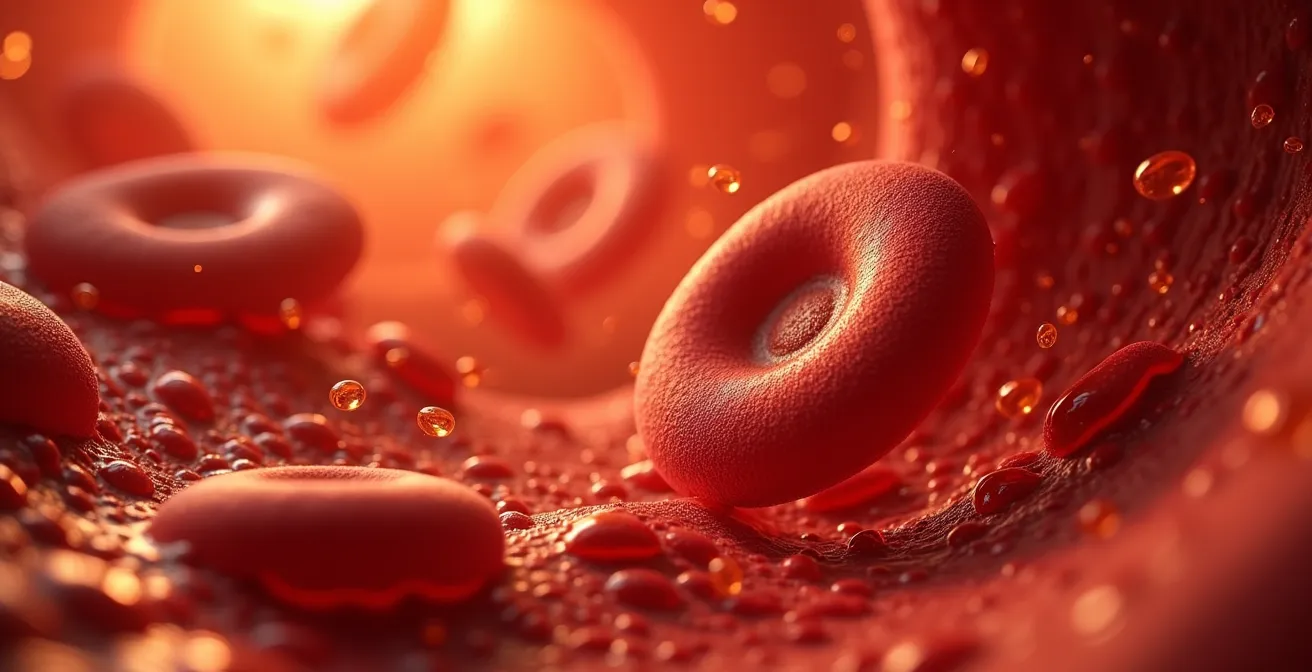
As the illustration suggests, without sufficient protein carriers, vitamins cannot complete their journey. This is a crucial, often-overlooked factor in supplementation. Many factors can alter albumin’s shape and its carrying capacity, making a comprehensive diet that supports robust protein synthesis essential. Ensuring you have enough raw material (dietary protein) to build these transport systems is a non-negotiable first step for any supplementation strategy to be effective.
The Magnesium Deficiency Signs That 60% of Adults Ignore
Magnesium is a perfect case study in the gap between dietary intake and cellular need. This essential mineral is a cofactor in over 300 enzymatic reactions in the body, governing everything from muscle function and nerve signaling to blood glucose control and energy production. Yet, it’s one of the most common deficiencies. An analysis of NHANES data found that 48% of Americans consume less than the recommended amount of magnesium from food. The actual deficiency rate is likely higher, as certain populations, like those over 60, are more prone to low levels.
The signs of deficiency are often subtle and easily dismissed as modern-day stress: muscle twitches or cramps, fatigue, mental fog, anxiety, and poor sleep. Because these symptoms are so common, they are frequently ignored. However, they can be your body’s early warning system for a significant mineral gap. Whole food sources like whole grains (brown rice, oats), nuts, seeds, and leafy greens are rich in magnesium, but supplementation is often necessary to correct a deficiency.
When turning to supplements, the chemical form is paramount. The bioavailability of magnesium varies dramatically depending on what it’s bound to. A cheap form like magnesium oxide has very poor absorption and is more likely to cause a laxative effect than to replenish your cellular levels. Understanding the different forms allows you to choose a targeted, effective supplement.
This table, based on information from the Cleveland Clinic, breaks down the most common forms of magnesium and their primary uses, demonstrating that “magnesium” is not a one-size-fits-all supplement.
| Form | Bioavailability | Best For |
|---|---|---|
| Magnesium Oxide | Low (approx. 4%) | Laxative effect |
| Magnesium Glycinate | High | Sleep, anxiety, low stress on the gut |
| Magnesium L-threonate | High | Brain health, cognitive function |
| Magnesium Citrate | Moderate | General use, constipation relief |
Choosing a highly bioavailable form like magnesium glycinate for sleep or magnesium L-threonate for brain health ensures the nutrient is absorbed and utilized, rather than contributing to the “expensive urine” problem. This highlights the importance of not just supplementing, but supplementing smartly.
The Fat-Soluble Vitamin Mistake That Can Damage Your Liver
The common “more is better” approach to supplementation is not just ineffective—it can be dangerous, especially with fat-soluble vitamins (A, D, E, and K). Unlike water-soluble vitamins (like B and C), which are easily excreted in urine if taken in excess, fat-soluble vitamins are stored in the body’s fatty tissues and the liver. This capacity for storage means they can accumulate to toxic levels over time, a condition known as hypervitaminosis.
Synthetic versions of these vitamins pose a particular risk. High doses of synthetic vitamin A (retinyl palmitate) or vitamin E (dl-alpha-tocopherol) can place significant strain on the liver. The Sunwarrior Health Hub provides a stark warning about this, noting the difference in how the body handles natural versus synthetic forms:
High doses of synthetic fat-soluble vitamins (like A, D, and E) can accumulate in the liver and cause toxicity. Studies have also linked synthetic beta-carotene to increased cancer risk in smokers.
– Sunwarrior Health Hub, Whole Food Vitamins vs Synthetic Vitamins
This happens because whole-food sources provide vitamins in a complex with other nutrients that help regulate their absorption and use. For example, plant-based vitamin A comes as carotenoids, which the body converts to active vitamin A only as needed, providing a natural safety mechanism. In contrast, high-dose synthetic vitamin A bypasses this regulation. To avoid this common but serious mistake, it’s crucial to handle fat-soluble vitamins with respect and informed caution.
Action Plan: Safe Supplementation of Fat-Soluble Vitamins
- Context is Key: Always take fat-soluble vitamins (A, D, E, K) with a meal that contains dietary fat (like avocado, olive oil, or nuts) to ensure proper absorption.
- Monitor Doses: Be mindful that these vitamins accumulate. Avoid mega-dosing unless under specific medical guidance and choose food-based sources when possible.
- Test, Don’t Guess: If you are taking high doses of supplements like Vitamin D, get regular blood tests to monitor your levels and prevent accumulation to toxic ranges.
- Ensure Synergy: When supplementing with vitamin D, ensure you have adequate vitamin K2 intake, as they work synergistically to direct calcium to the bones and away from arteries.
- Prioritize Food First: Rely on whole food sources like cod liver oil (A & D), sunflower seeds (E), and leafy greens (K) as your primary intake, using supplements to fill specific, measured gaps.
By following these principles, you can harness the benefits of fat-soluble vitamins while mitigating the significant risks associated with their improper use.
When to Take Zinc and Copper to Avoid Competition for Absorption?
The biochemical world inside your gut is a competitive environment. Many minerals use the same protein channels to pass from the intestine into the bloodstream. When two or more minerals that share a pathway are ingested at the same time in high supplemental doses, they engage in a process called competitive inhibition. Essentially, they fight for the same “doorways,” and the mineral present in a higher amount often wins, blocking the absorption of the other. This is a critical concept to understand for effective supplementation.
The relationship between zinc and copper is the textbook example of this phenomenon. Both are essential trace minerals, but they compete for absorption in the small intestine. Taking high doses of zinc over a prolonged period can lead to a copper deficiency, as the zinc effectively floods and monopolizes the shared absorption pathways. A copper deficiency can manifest as fatigue, weak bones, and neurological problems. This is why many well-formulated supplements either contain a balanced ratio of zinc to copper or why it’s advised to take them separately.
This abstract illustration shows how different minerals, represented by metallic spheres, must navigate the intestinal landscape to be absorbed. When too many of one type are present, they can block the path for others.

To avoid this nutritional traffic jam, timing is everything. The solution is not to avoid one mineral, but to give each one uncontested access to the absorption channels. The general scientific recommendation is to take zinc and copper supplements at least 2 hours apart. For instance, you could take zinc with breakfast and copper with lunch. This simple scheduling strategy prevents competitive inhibition and ensures your body gets the full benefit of both essential minerals, turning a potential conflict into a synergistic partnership.
Why Spinach Losing 50% of Its Nutrients After 3 Days in Transit?
The “eat a balanced diet” argument often presumes that the food on our plate is as nutritious as it was at the moment of harvest. The biochemical reality is that fruits and vegetables are still living organisms post-harvest, and they begin to lose their nutritional value immediately. This process, known as post-harvest nutrient degradation, is a major, often invisible, factor in the nutrient density of our food. Delicate, water-soluble vitamins like Vitamin C and folate (B9) are particularly vulnerable.
Consider a head of spinach. From the moment it’s picked, its cells continue to respire, consuming sugars and breaking down vitamins. Exposure to heat, light, and oxygen accelerates this decline. Research has shown that spinach can lose over half of its folate content within a few days of refrigerated storage, and Vitamin C degrades even faster. The “fresh” spinach you buy at a supermarket may have traveled for days or even weeks, sitting in distribution centers and on trucks. By the time it reaches your kitchen, its nutritional profile can be a shadow of its former self.
This isn’t a new problem, but it’s an accelerating one. The long-distance, centralized nature of the modern food supply chain is fundamentally at odds with nutrient preservation. This degradation means that even someone eating a diet rich in fruits and vegetables may not be getting the levels of vitamins and minerals they believe they are. This systemic decline in nutrient density is a powerful argument for both sourcing food as locally as possible and for considering targeted, high-quality supplementation to bridge the inevitable gaps created by our food system.
The solution isn’t to give up on healthy eating, but to become more strategic about it. Understanding that time and distance are the enemies of nutrition empowers you to seek out fresher, more local food sources, which inherently retain more of their vital compounds. It reframes the supplement debate: supplements are not just for poor diets, but can also be a tool to compensate for the shortcomings of an otherwise “healthy” modern diet.
Thermogenics vs. Cold Exposure: Which Safely Activates Brown Fat?
The activation of brown adipose tissue (BAT), or brown fat, is a fascinating area of metabolic health. Unlike white fat which stores energy, brown fat burns energy to produce heat, a process called thermogenesis. Activating BAT is a promising strategy for improving metabolic rate and body composition. This can be achieved through methods like cold exposure or by consuming thermogenic compounds. However, the underlying biochemical machinery of thermogenesis is entirely dependent on a steady supply of specific micronutrients.
Whether you’re taking a cold plunge or using a thermogenic supplement, the process will not be efficient without the right nutritional cofactors. These nutrients are not the fuel itself, but the spark plugs and gears that make the engine run. For example, iron is essential for transporting oxygen to BAT cells, which have a high oxygen demand. Thyroid hormones, which regulate metabolic rate, cannot be produced without adequate iodine and selenium. And the entire energy production cycle within the mitochondria of brown fat cells relies heavily on a full spectrum of B-vitamins.
A deficiency in any one of these key nutrients can create a bottleneck, limiting your body’s ability to generate heat and burn calories, regardless of the stimulus. Therefore, before investing in complex biohacking techniques, a foundational step is to ensure your nutritional status is robust. The following nutrients are particularly critical for supporting healthy thermogenic processes:
- Iron: For oxygen transport to energy-demanding brown fat cells.
- Iodine: Essential for the synthesis of thyroid hormones, the body’s primary metabolic regulators.
- B-Vitamins: Critical for mitochondrial energy metabolism and converting fuel into cellular energy (ATP).
- Selenium: Works with iodine in thyroid hormone conversion and function.
- Magnesium: Acts as a cofactor for hundreds of metabolic enzymes, including those involved in energy production.
This illustrates the principle of nutrient synergy. Activating a complex biological pathway like thermogenesis isn’t about a single magic bullet; it’s about ensuring the entire interdependent system is nutritionally supported. Without this foundation, efforts to boost metabolism can be ineffective and frustrating.
Key Takeaways
- Bioavailability is king: The chemical form and molecular structure of a vitamin determine its absorption, not just the dose.
- Nutrients don’t work in isolation; they rely on protein transporters, cofactors, and can compete for absorption pathways.
- The modern food supply chain leads to significant nutrient degradation, making even a “healthy” diet potentially deficient.
How to Grocery Shop at a Farmers Market to Maximize Nutrient Density?
Now that we have deconstructed the complexities of bioavailability, transport, and nutrient degradation, the path forward becomes clear: maximize nutrient density at its source. While high-quality, bioavailable supplements can fill critical gaps, the foundation of health remains whole foods. However, “shopping for vegetables” is too generic. The goal is to shop for peak nutrient density, and a local farmers market is your best laboratory for this.
Unlike a supermarket, a farmers market shortens the supply chain, drastically reducing the time between harvest and your plate. This minimizes the post-harvest nutrient degradation we discussed earlier. You are getting produce at or near its nutritional peak. Furthermore, you have the opportunity to engage with the growers and learn about their practices. Healthy soil, rich in microbial life, produces more nutrient-dense plants. A farmer who prioritizes soil health is your greatest ally in this quest.
To transform your grocery trip into a strategic mission for nutrients, apply your new biochemical knowledge. Think in terms of synergy and bioavailability. For example, when you see iron-rich leafy greens, also pick up vitamin C-rich bell peppers or tomatoes, as vitamin C dramatically enhances non-heme iron absorption. Pair fat-soluble vitamin sources like carrots (beta-carotene) with an avocado to ensure you’re getting the healthy fats needed to absorb them. Your shopping basket can become a well-formulated, synergistic recipe.
To put this into practice, here is a simple guide to navigating a farmers market with nutrient density as your primary goal:
- Ask About the Soil: Inquire with farmers about their practices. Do they use cover crops, compost, or crop rotation? Healthy soil is the foundation of nutrient-dense food.
- Choose Deep Colors: The vibrant colors of fruits and vegetables—the deep purple of beets, the bright orange of carrots, the dark green of kale—are often indicative of a high concentration of antioxidants and phytonutrients.
- Buy Seasonal and Ripe: Produce that is picked at its peak ripeness and in season contains the highest levels of vitamins and antioxidants. It’s when the plant has fully matured its nutritional profile.
- Create Synergistic Pairs: Think about nutrient pairings as you shop. Buy iron-rich greens alongside vitamin C sources (peppers, citrus) and sources of beta-carotene (carrots, sweet potatoes) alongside healthy fats (avocados).
By applying these principles, you move from being a passive consumer to an active, informed health optimizer, ensuring that what you eat has the maximum potential to be absorbed and utilized by your body.
Now that you are equipped with the biochemical knowledge to discern quality, your next step is to apply this lens to your own diet and supplement regimen. Evaluate what you are currently taking and eating not by the label, but by its likely bioavailability and synergistic potential.